
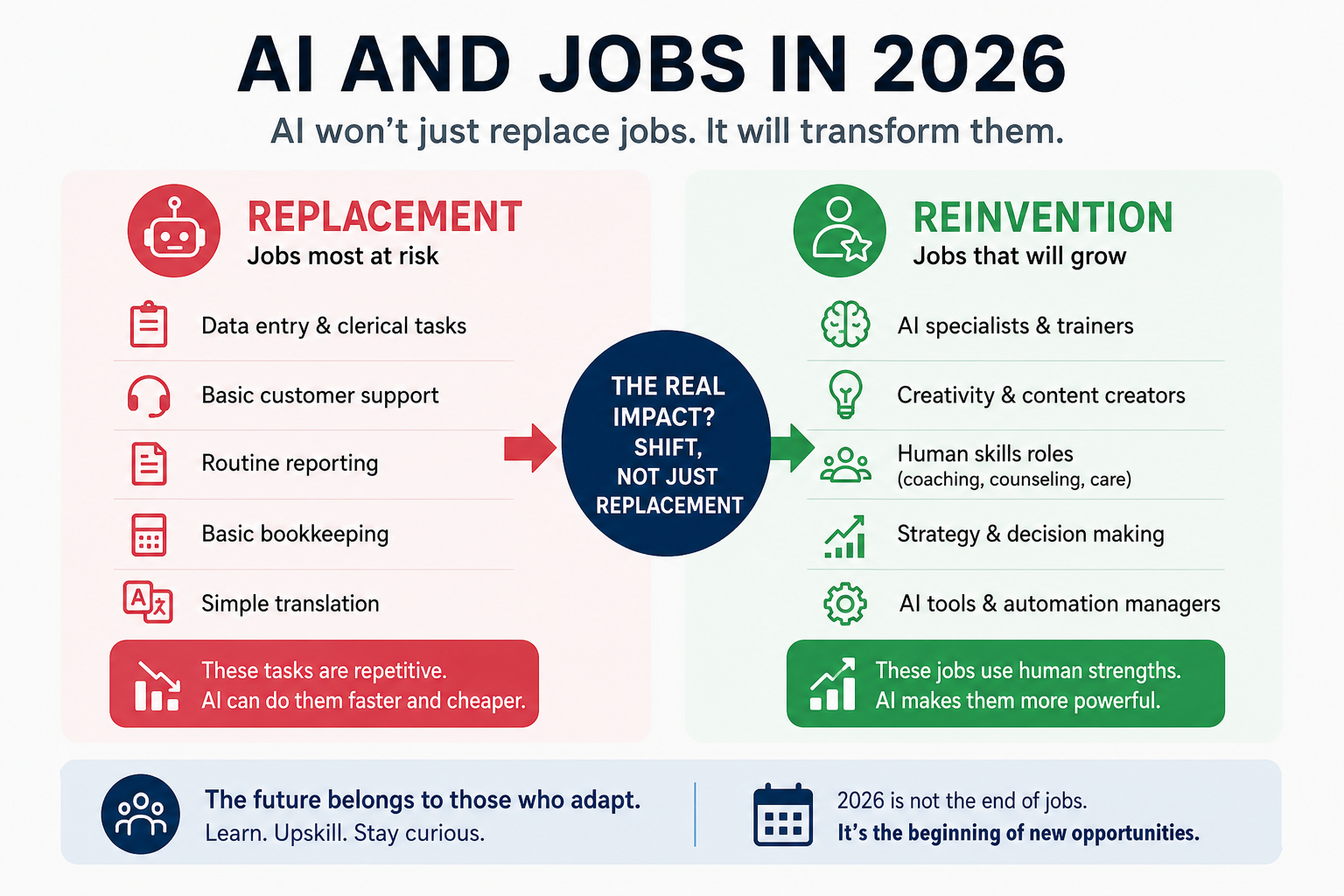
Replacement or Reinvention? The real impact of AI on Jobs and Employment in 2026.
When calculator was invented, mathematics didn’t disappear, they just stopped doing long division by hand. AI is acting as the ultimate intellectual calculator. If your value at work relies entirely on predictable, repetitive, data driven outputs, replacement is a real threat. But if you can use these tools to scale your unique human judgement, strategy, and empathy, you are not being replaced, you are being supercharged.
Artificial Intelligence (AI) is no longer a futuristic concept. It has become an integral part of workplaces across industries, influencing how businesses operate and how employees perform their duties. From customer service chatbots and automated data analysis to self-driving technologies and content generation tools.
This article explores the reality of AI’s impact on jobs and employment in 2026, examining both the challenges and opportunities that accompany this technological revolution.
The Rise of AI in the workplace
The rapid advancement of AI technologies has enabled businesses to automate repetitive and time time-consuming tasks. Organizations now use AI to process large amounts of data, predict consumer behavior, manage supply chains, and improve decision-making.
Industries such as healthcare, finance, manufacturing, education, and transportation have embraced AI solutions to enhance efficiency and reduce operational costs. As a result, employees are increasingly working alongside intelligent systems that assist them in performing their jobs more effectively.
Rather than replacing every worker, AI has become a powerful tool that compliments human skills, allowing workers to focus on tasks that require creativity, critical thinking, emotional intelligence and strategic decision-making.
Jobs Most Affected by AI
Certain occupation have experienced significant disruption due to automation. Jobs involving routine, repetitive and predictable tasks are particularly vulnerable.
Examples includes:
- Data entry clerks
- Basic customer service representatives
- Bookkeeping assistants
- Cashiers
- Manufacturing assembly workers
- Administrative support roles
AI-powered software can now complete many of these tasks faster and more accurately than humans. For businesses, this translates into lower costs and improved productivity.
However, the decline of some traditional roles does not necessarily mean permanent unemployment. Many affected workers are transitioning into new positions that require more advanced technical and interpersonal skills.
New Opportunities Created by AI
While AI has displaced certain jobs, it has also generated entirely new career paths. The demand for professionals who can develop, manage and work with AI systems continues to grow.
Some of the fastest-growing AI-related careers in 2026 includes:
- AI Engineers
- Machine Learning Specialists
- Data Scientists
- AI Ethics Consultants
- Cybersecurity Analysts
- Prompt Engineers
- AI Product Managers
- Automation Specialists
Beyond technical roles, AI has also created opportunities in training, education, consulting, and digital content management. Businesses need workers who can understand AI tools and apply them effectively within their industries.
This shift demonstrates that technological advancement often changes the types of jobs available rather than eliminating work altogether.
Reinvention of Existing Roles
One of the most significant effects of AI in 2026 is the transformation of existing jobs.
For example, doctors now use AI-assisted diagnostic systems to identify diseases more accurately. Teachers leverage AI-powered learning platforms to personalize education for students. Marketing professionals use AI tools to analyze consumer behavior and create targeted campaigns.
In each case, AI enhances human capabilities rather than replacing professionals completely.
Employees who embrace AI are finding that it allows them to become more productive and efficient. Instead of spending hours on repetitive tasks, workers can focus on innovation, problem-solving, and building stronger relationships with customers and colleagues.
The future workplace is increasingly defined by collaboration between humans and machines.
The skills Employers Now Demand
As AI continues to reshape the labor market, Employers are placing greater emphasis on skills that technology cannot easily replicate.
These includes:
- Critical Thinking
- Creativity
- Emotional Intelligence
- Digital Literacy
- Adaptability
Critical Thinking
Employees must be able to analyze information, evaluate outcomes, and make informed decisions.
Creativity
Innovation remains a unique human strength that helps businesses develop new products, services, and solutions.
Emotional Intelligence
The ability to understand and manage emotions is essential in leadership, customer service, healthcare, and teamwork.
Digital Literacy
Workers need a basic understanding of AI tools and digital technologies to remain competitive.
Adaptability
The willingness to learn and adapt to new technologies has become one of the most valuable workplace skills.
Individuals who continuously update their knowledge and skills are better positioned to thrive in an AI-driven economy.
Challenges and Concerns
Despite its benefits, AI adoption presents several challenges.
- Job Displacement
- Skill Gap
- Income Inequality
- Ethical Issues
Job Displacement
Workers in highly automated industries may face temporarily unemployment while transitioning to new roles.
Skills Gap
Many employees lack the technical skills required to work effectively with AI technologies.
Income Inequality
There is concerns that AI could widen the gap between highly skilled professionals and lowly-skilled workers
Ethical Issues
Questions surrounding privacy, bias, transparency and accountability continues to challenge policymakers and organization.
Governments, businesses and educational institutions must work together to address these issues through training programs, responsible AI regulations and workforce development initiatives.
The Role of Education and Reskilling
Education has become one of the most important tools for preparing workers for the future.
Universities, online learning platforms, and vocational training centers are increasingly offering AI-related courses and certifications. Lifelong learning is no longer optional; it is essential.
Reskilling programs help workers transition from declining occupations in emerging fields. By investing in education and training, societies can reduce the negative impacts of automation and ensure that more people benefit from technological progress.
Employers are also taking responsibility by providing employees with opportunities to learn new skills and adapt to changing workplace demands.
The Future of Work Beyond 2026
Looking beyond 2026, AI is expected to become even more sophisticated. However, history suggests that technological revolutions rarely eliminate work altogether. Instead, they create new industries, transform existing professions, and increase productivity.
The future workforce will likely consist of individuals who can successfully combine human strengths with technological capabilities. Workers who embrace continuous learning, adaptability, and innovation will remain valuable regardless of how technology evolves.
Rather than competing against AI, many professionals will find success by learning how to work alongside it.
Conclusion
The debate surrounding AI and unemployment often focuses on whether machines will replace humans. The reality in 2026 is more complex. While AI has automated certain tasks and reduced demand for some traditional roles, it has also created new opportunities, transformed existing jobs, and increased productivity across industries.
The true impact of AI is not simply replacement, it is reinvention. Workers, businesses and governments must adapt to this changing landscape by investing in education, reskilling and responsible innovation.
Those who view AI as a tool for growth rather than threat are likely to benefit the most from the opportunities it presents. In the end, the future of work will not be defined solely by artificial intelligence, but by how humans choose to use it.