
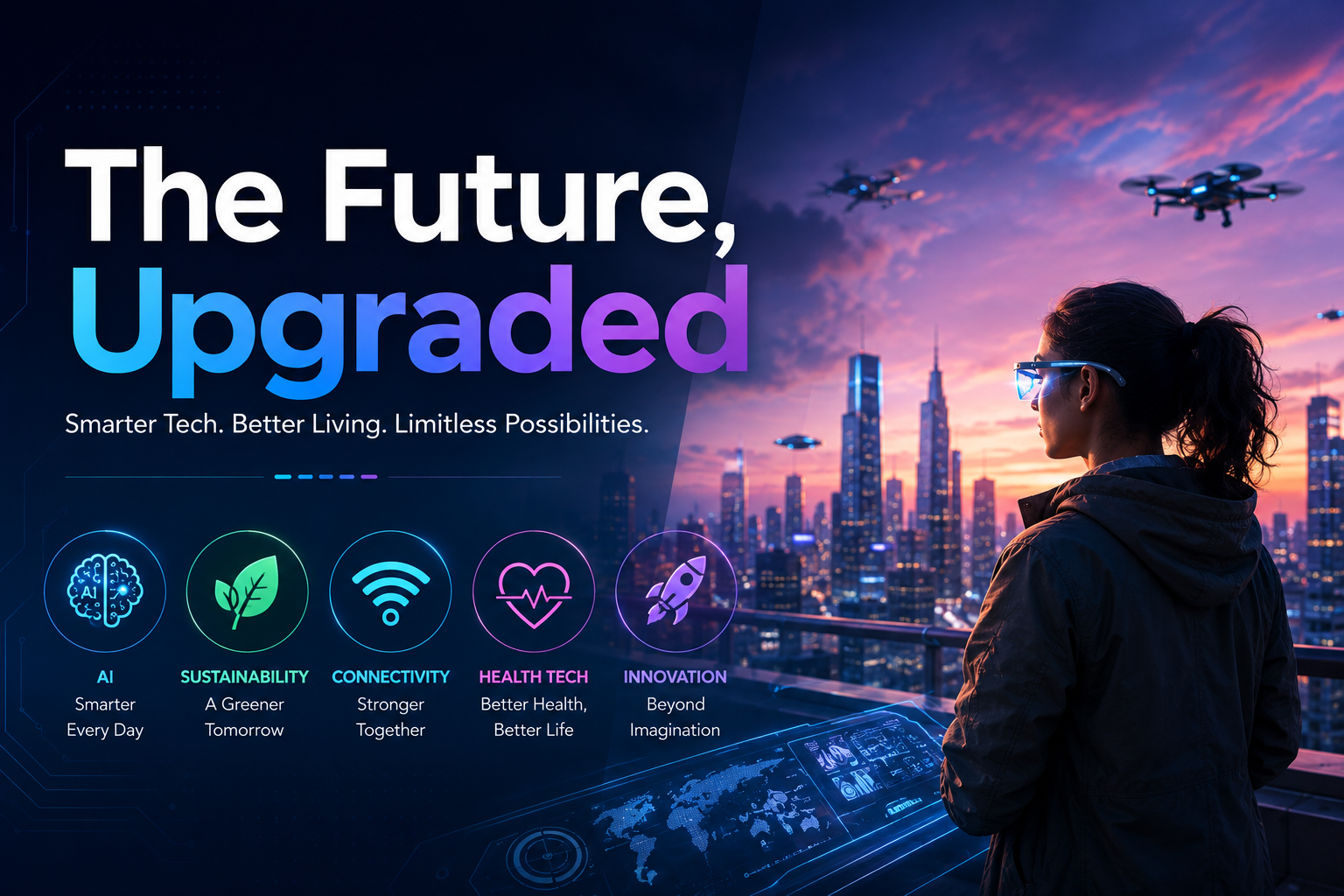
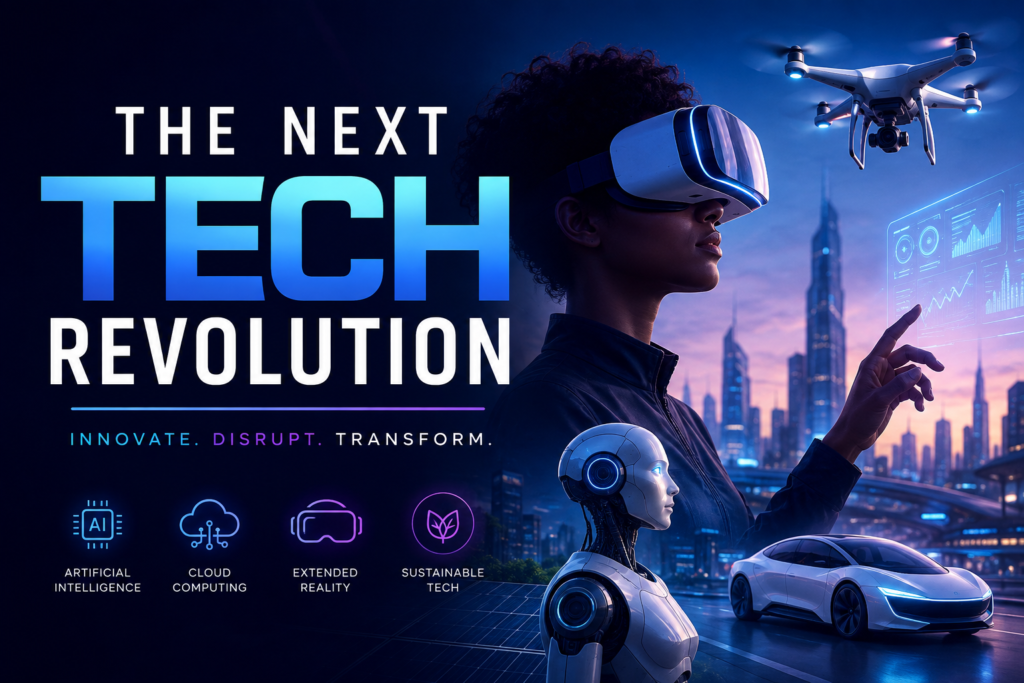
The Future Got an Upgrade: The Technologies Reshaping Tomorrow
When the Future Was Still a Dream
In 1969, millions of people around the world gathered around black-and-white television sets to witness something that had once belonged only in science fiction: humans walking on the Moon. It was a moment that proved technology could turn imagination into reality.
But that was not the first time humanity had experienced such a leap. More than a century earlier, the Industrial Revolution transformed societies with steam engines, factories, and railways. Electricity followed, lighting cities that had once disappeared into darkness after sunset. Then came the telephone, allowing voices to travel across continents. Radio connected nations, television changed entertainment, and computers revolutionized business and education.
The arrival of the Internet in the late 20th century marked another historic turning point. Suddenly, knowledge was no longer confined to libraries, and communication was no longer limited to geography. Smartphones soon placed the worlds information into our pockets, changing how we work, learn, shop, and interact with one another.
Each technological revolution has shared one thing in common: people initially questioned whether these innovations would truly change the world. History has repeatedly answered that question with a resounding “yes.”
Today, we are standing at the beginning of another transformation. Artificial intelligence, quantum computing, robotics, biotechnology, renewable energy, and next-generation connectivity are advancing faster than many experts predicted. The future is not waiting decades to arrive—it is unfolding before our eyes.
The future has just received an upgrade.
Why Technology Is Advancing Faster Than Ever
Unlike previous eras, today’s innovations build upon one another. Artificial intelligence improves scientific research. Cloud computing accelerates software development. Faster Internet enables connected devices. Better processors power smarter machines.
Because these technologies are interconnected, progress happens at an extraordinary pace.
Several factors are driving this acceleration:
- Increased global investment in research
- Faster computing power
- Massive amounts of digital data
- Collaboration across countries
- Open-source software communities
- Growing demand for automation and efficiency
The result is a cycle where every breakthrough helps create the next one.
Artificial Intelligence Is Becoming a Daily Companion
Artificial intelligence is no longer limited to research laboratories. It has become part of everyday life.
AI helps recommend movies, filter spam emails, translate languages, navigate traffic, recognize speed, detect financial fraud, and assist doctors in identifying diseases.
Businesses use AI to analyze customer behavior, improve productivity, and automate repetitive tasks. Students rely on AI-powered learning tools, while content creators use AI for editing, brainstorming, and design assistance.
Rather than replacing every human job, AI is increasingly becoming a tool that helps people work faster and make better decisions.
The future workplace is likely to feature humans and intelligent machines working side by side.
Smarter Cities Are Becoming Reality
Cities are becoming more connected through technology.
Smart traffic systems reduce congestion by adjusting signals in real time. Intelligent streetlights save electricity by dimming
when roads are empty. Waste collection routes become more efficient through sensors that monitor bin capacity.
Public transportation is also improving through digital ticketing, live tracking, and predictive maintenance.
These technologies create cities that are safer, cleaner, and more efficient while reducing environmental impact.
Healthcare Is Entering a New Era
Medicine has benefited enormously from technological innovation.
Doctors now use AI-assisted imaging to identify diseases earlier. Wearable devices continuously monitor heart rate, sleep, and physical activity. Telemedicine allows patients to consult healthcare professionals without traveling long distances.
Researchers are also exploring personalized medicine, where treatments are tailored to an individual’s genetic profile.
Robotic surgery continues to improve precision, while biotechnology offers hope for treating diseases that once had limited treatment options.
Technology is shifting healthcare from reacting to illness toward preventing it.
Education Without Borders
Education has changed dramatically over the past decade.
Students can attend online classes from anywhere in the world, access digital libraries instantly, and learn through interactive simulations.
Virtual reality allows learners to explore ancient civilizations, perform scientific experiments safely, or practice technical skills in realistic environments.
AI-powered tutors provide personalized learning experiences by identifying areas where students need extra support.
This new educational landscape makes learning more flexible and accessible than ever before.
The Workplace Is Being Reinvented
The traditional office is evolving.
Remote work, cloud computing, video conferencing, and digital collaboration tools have made location less important than productivity.
Automation handles repetitive tasks, allowing employees to focus on creative thinking, problem-solving, and strategic planning.
At the same time, new careers continue to emerge in fields such as:
- Artificial intelligence
- Cybersecurity
- Data science
- Cloud computing
- Robotics
- Digital marketing
- Software development
- Renewable energy
The future workforce will value adaptability and continuous learning more than ever before.
Transportation Is Becoming Smarter
Transportation is undergoing significant transformation.
Electric vehicles are becoming increasingly common as governments and manufacturers invest in cleaner alternatives.
Self-driving technology continues to improve through better sensors, cameras, and AI systems.
Public transportation is becoming more connected through mobile applications that provide live schedules and route optimization.
Even drone technology is finding applications in agriculture, logistics, emergency response, and infrastructure inspection.
The goal is transportation that is safer, cleaner, and more efficient.
Homes That Think for Themselves
Smart homes have evolved beyond novelty.
Voice assistants can control lighting, security systems, appliances, and entertainment devices.
Smart thermostats learn household routines and reduce energy consumption.
Security cameras send instant alerts when unusual activity is detected.
Connected appliances help reduce waste while improving convenience.
As the Internet of Things expands, more everyday devices will communicate seamlessly with one another.
The Rise of Sustainable Technology
The future is not only about smarter technology—it is also about greener technology.
Renewable energy sources such as solar and wind continue to become more efficient and affordable.
Battery technology is improving, making electric transportation and energy storage more practical.
Artificial intelligence helps optimize electricity distribution, reducing waste, and lowering emissions.
Innovations in recycling, sustainable manufacturing, and environmentally friendly materials are helping industries reduce their environmental impact.
Technology will play a critical role in addressing climate challenges.
Cybersecurity Will Matter More Than Ever
As our lives become increasingly digital, protecting information becomes more important.
Cybercriminals are constantly developing new techniques to exploit vulnerabilities.
Organizations are responding by investing heavily in cybersecurity technologies, including:
- Multi-factor authentication
- Encryption
- AI-powered threat detection
- Cloud security
- Zero-trust security models
Individuals also have an important role by creating strong passwords, recognizing scams, and keeping devices updated.
Digital trust will become one of the foundations of the future economy.
The Challenges Ahead
Every technological revolution brings opportunities and challenges.
Some concerns include:
- Job displacement through automation
- Data privacy
- Cybersecurity threats
- Ethical use of artificial intelligence
- Digital Inequality
- Misinformation
- Environmental impact of data centers
Governments, businesses, researchers, and citizens must work together to ensure technology benefits society responsibly.
Innovation should improve lives rather than creating unnecessary risks.
Preparing for Tomorrow
No one can predict every invention that lies ahead, but we can prepare for change.
Some valuable skills are:
- Digital literacy
- Critical thinking
- Creativity
- Communication
- Adaptability
- Problem-solving
- Continuous learning
Technology will continue to evolve, and those willing to learn will be better positioned to thrive.
Looking Beyond 2030
Experts expect remarkable advances over the next decade.
We may see:
- More capable AI assistants
- Widespread smart infrastructure
- Improved renewable energy systems
- Faster communication networks
- Greater medical breakthroughs
- More autonomous transportation
- Expanded space exploration
- Powerful quantum computers solving problems once considered impossible.
While not every prediction will become reality, history suggests that technological progress rarely slows for long.
Conclusion: Building the Next Chapter
Every generation witnesses invention that redefine what is possible. From the steam engines to electricity, from the internet to smartphone, each breakthrough has expanded human potential.
Today’s innovation represent another chapter in that remarkable story. Artificial intelligence is helping solve complex problems. Smarter cities are improving daily life. Healthcare is becoming more personalized. Education is reaching more people than ever before. Sustainable Technologies are helping protect the planet.
The future is not a distant destination waiting for us. It is something we are actively building through innovation, curiosity, and collaboration.
As technology continues to evolve, one thing becomes increasingly clear: the future has not simply arrived—it has just received an upgrade.