
 Inside a Smartphone: The Silicon Chip Powering Your Device
A smartphone can fit inside a pocket, yet it performs tasks that once required enormous computers. It processes photographs, runs sophisticated applications, recognises speech, manages internet connections and performs billions of calculations.
The remarkable part is that much of this computing activity depends on a tiny electronic component hidden inside the device: The smartphone processor.
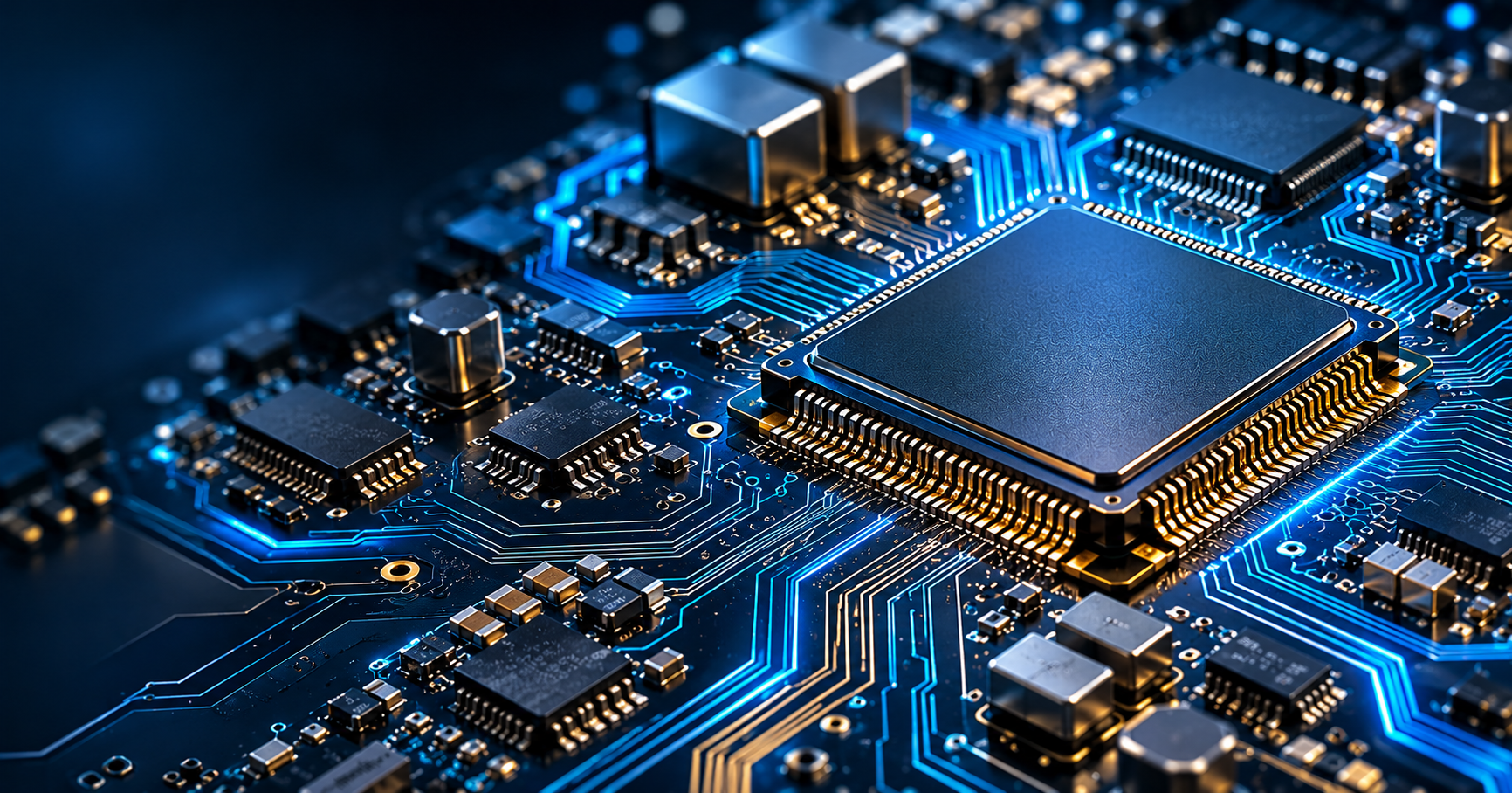
Beneath its protective packaging lies an intricate arrangement of microscopic electronic structures, manufactured with extraordinary precision. These structures work together to interpret instructions, process information and coordinate the activities of the smartphone.
But how does a small piece of silicon become powerful enough to perform so many tasks? And what happens during the engineering process that creates it?
To understand the smartphone, we must first understand the technology that makes modern computing possible.
Silicon: The Material Behind Modern Computing
The story of the smartphone processor begins with silicon, a chemical element found abundantly in the earth crust.
Silicon is present in many materials and is a major component of sand. However, the material used in electronic chips must undergo extensive purification before it can be used in semiconductor manufacturing.
Its importance comes from a special electrical property: Silicon is a semiconductor.
Unlike copper, which conducts electricity easily, or rubber, which resists electrical current, silicon allows engineers to control how electricity moves through it.
This makes it possible to manufacture electronic components that regulate electrical signals.
By introducing carefully controlled impurities into silicon, manufacturers can change its electrical behaviour. This process, called doping, helps create the semiconductor structures used in transistors.
Silicon became the foundation of modern electronics because engineers learned how to control its electrical properties with extraordinary precision.
That discovery helped transform computing from a technology requiring enormous machines into something that could eventually fit inside a smartphone.
The Transistor: The Tiny Switch That Changed Everything
Before modern smartphone processors existed, electronic computers relied on much larger components called vacuum tubes.
These components could control electrical signals, but they consumed considerable power, generated heat and occupied significant space.
A major breakthrough came in December 1947, when John Bardeen and Walter Brattain demonstrated the first working point-contact transistor at Bell Laboratories. William Shockley subsequently contributed to the development of transistor technology.
The transistor changed the direction of electronics.
A transistor can control or amplify electrical signals. In digital processors, transistors are commonly used as microscopic switches that represent information through two electrical states, interpreted as 0 and 1.
These binary values form the foundation of digital computing.
Think if a conventional light switch. It controls whether electricity flows through a circuit. A transistor performs a related function electronically, but at a microscopic scale and at extraordinary speeds.
Modern smartphone chips contain billions of transistors.
Individually, these tiny components perform relatively simple operations. Connected in carefully designed arrangements, they form logic gates and increasingly complex electronic circuits.
These circuits eventually become the processing systems responsible for running smartphone software.
A smartphone processor does not depend on one extraordinary intelligent component. Its capabilities emerge from billions of tiny electronic devices working together.
How a Smartphone Processor Is Manufactured
Creating a smartphone chip requires specialized factories, advanced machinery and highly controlled manufacturing conditions.
The process begins with a highly purified silicon crystal, which is sliced into thin, circular discs called silicon wafers.
These wafers provide the foundation for manufacturing electronic circuits.
One of the most important techniques used is photolithography.
Photolithography involves transferring microscopic circuit patterns onto a wafer using light.
The process begins by coating the wafer with a light-sensitive chemical photoresist. Specialised optical equipment then projects patterns onto the coated surface.
After exposure and development, selected areas are prepared for further manufacturing operations.
Other processes, including etching, deposition and ion implantation, help create the transistor structures and electrical connections.
These operations are repeated many times to build the complex arrangement of circuits required by the processor.
Once manufacturing is complete, the wafer is divided into individual pieces called dies. The dies are tested, and suitable ones are packed to protect their delicate structures and provide electrical connections.
The precision involved is extraordinary. Even tiny manufacturing defects can affect the performance and reliability of a chip.
This is why semiconductor manufacturing takes place in specialized cleanrooms, where temperature, humidity and airborne particles are carefully controlled.
What Happens Inside the Smartphone Chip?
The smartphone processor is responsible for much more than performing calculations. It coordinates different computing activities that allow the device to function.
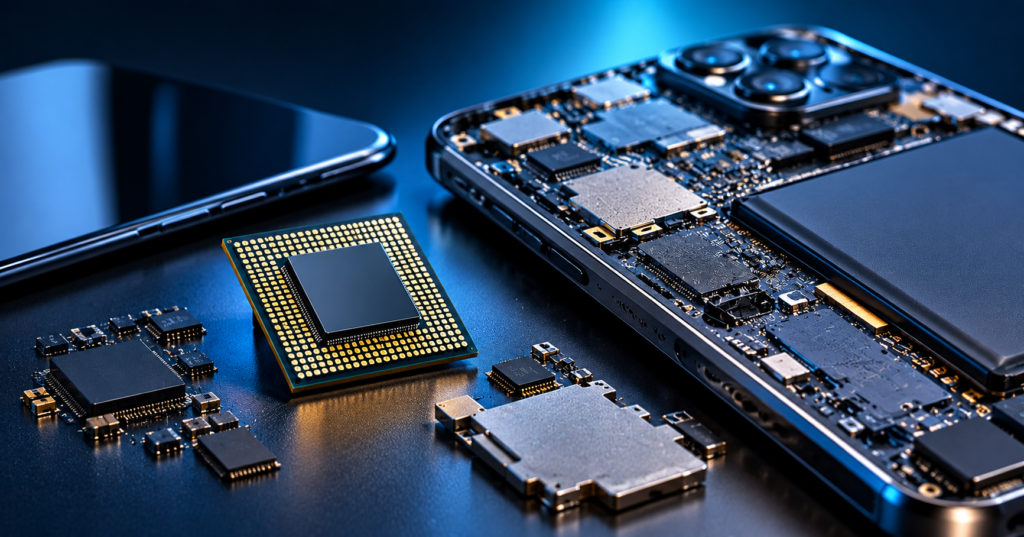
Most modern smartphones use a system-on-a-chip (SoC), which combines several important processing functions into one integrated chip.
These functions include:
The CPU (Central Processing Unit)
The CPU executes instructions from software. When you open an application, switch between menus or perform a calculation, the CPU handles many of the instructions involved.
It is designed to perform a wide range of general computing tasks.
The GPU (Graphics Processing Unit)
The GPU handles graphics-related calculations. It helps produce the images and animations displayed on your screen.
When you play a mobile game or watch visually demanding content, the GPU performs much of the graphics processing required.
The NPU (Neutral Processing Unit)
Many modern smartphone chips include specialised processors designed to accelerate artificial intelligence and machine-learning tasks.
These units can support functions such as speech recognition, image enhancement and certain on-device AI features.
The ISP (Image Signal Processor)
The ISP processes information captured by the smartphone camera sensor. It helps manage colour, exposure, noise reduction and other image-processing operations.
Together, these specialised units allow a smartphone to handle different tasks efficiently.
They also explain why a modern smartphone processor is better understood as a collection of interconnected computing systems rather than one simple processing unit.
Why Smartphone Chips Are Measured in Nanometres
Smartphone advertisements frequently mention processors manufactured using 3nm, 4nm or 5nm technology.
These numbers refer to semiconductor manufacturing process generations, commonly known as process nodes.
A nanometre is one-billionth of a metre.
To appreciate the scale, consider that a human hair can be tens of thousands of nanometres thick.
The structures inside advanced processors are incredibly small, allowing manufacturers to integrate enormous numbers of transistors into relatively limited space.
Historically, process-node names were more closely associated with particular physical transistor dimension. Today, however, a label such as 3nm does not directly represent one specific transistor measurement.
Why are these manufacturing advances important?
Smaller and more advanced process technologies can help manufacturers improve transistor density, performance and energy efficiency.
However, a smaller manufacturing node does not automatically guarantee a faster smartphone.
Processor architecture, software optimisation, cooling and power management also influence real-world performance.
Two smartphones using different manufacturing processes may therefore deliver surprisingly similar experience.
Why Does the Processor Make Your Smartphone Hot?
Have you noticed your smartphone becoming warm during games, video recording or extended use?
The processor is one possible source of that heat.
When electrical current moves through electronic circuits, some energy is converted into heat. This is known as power dissipation.
Demanding applications can increase processor activity and power consumption, producing additional heat.
Smartphone manufacturers use power-management and thermal-control technologies to manage this problem.
One technique is dynamic voltage and frequency scaling. It allows the processor to adjusts its operating speed and voltage depending on the workload.
When temperatures become excessive, the device may reduce processor performance. This is called thermal throttling.
Although it can make demanding applications run more slowly, thermal throttling helps protect internal components from excessive temperatures.
This reveals an important engineering challenge: Designing a powerful smartphone processor is not simply about making it faster. It must also operate efficiently within the limited space and cooling capacity of a handheld device.
From Early Computers to the Smartphone in Your Pocket
The smartphone processor represents decades of technological development.
In the 1950s, computers were significantly larger and less efficient than the devices we use today.
The invention of the transistor made electronic systems smaller and more practical.
Another important development followed in 1958 and 1959, when Jack Kilby and Robert Noyce independently developed important forms of the integrated circuit.
An integrated circuit allowed multiple electronic components to be combined on a single semiconductor substrate.
This development helped manufacturers produce increasingly sophisticated electronic systems.
In 1965, Gordon Moore made an influential observation about the rapid growth in the number of components that could be economically integrated onto a chip. His observation became known as Moore’s Law.
Over time, advances in semiconductor manufacturing, transistor architecture and chip design made processors increasingly powerful.
These developments eventually helped create the computing capabilities found in modern smartphones.
The device in your hand is therefore connected to a long history of discoveries in physics, materials science and electrical engineering.
Conclusion: The Engineering Inside a Tiny Chip
The smartphone processor is one of the most sophisticated components in modern consumer technology.
Its operation depends on billions of microscopic transistors, carefully engineered silicon structures and specialized computing units working together.
From the silicon wafer used in manufacturing to the circuits responsible for processing photographs and running applications, every stage requires remarkable scientific and engineering precision.
What appears to be a small electronic component is actually the result of decades of innovation.
And the processor is only one part of the story.
Inside the same smartphone is another remarkable engineering achievement: a rechargeable battery that converts chemical energy into electrical power.