

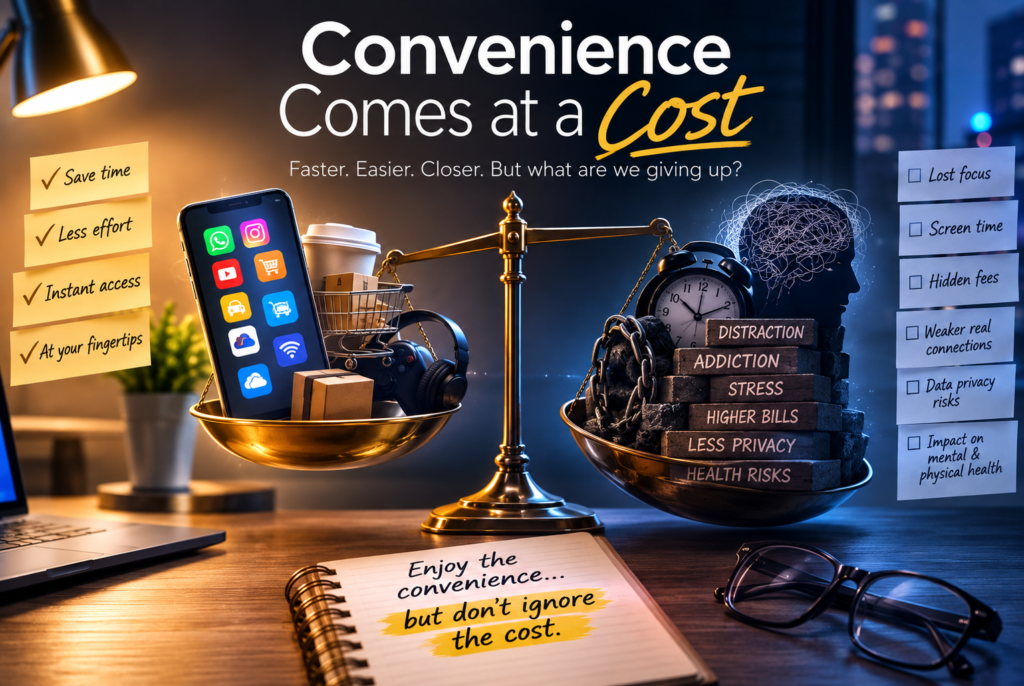
Convenience Comes at a Cost: The Hidden Price of Living in the Age of Ease
Envision stepping into a time machine and traveling back just thirty years. You wake up in the morning without a smartphone alarm. To call a friend, you walk to the nearest landline. Finding an unfamiliar address means unfolding a paper map. Paying bills requires standing in long queues at the bank. Shopping takes an entire afternoon, and watching your favourite movie depends on what is available at the local video rental store.
Now return to the present.
Your alarm rings from your smartphone. Your groceries arrive with a few taps. A ride appears within minutes. Your bank fits in your pocket, your office can be anywhere with an Internet connection, and most every question you have can be answered in seconds.
Human history has always been a story of making life easier. From the invention of the wheel to artificial intelligence, every major breakthrough has aimed to reduce effort, save time, and improve quality of life. Convenience is not a modern invention—it is one of the humanity’s oldest ambitions.
But every invention has a price.
The convenience we enjoy today has transformed the way we work, communicate, learn, and live. Yet beneath the speed and simplicity lies another story—one about privacy, dependence, environmental waste, declining patience, and hidden trade-offs that many people rarely stop to consider.
Convenience has become one of the greatest achievements of modern technology, but it has also become one of the greatest paradoxes. The easier life becomes, the more important it is to ask a simple question:
What are we giving up in exchange for convenience?
The Rise of the Convenience Economy
Today’s world is built around reducing friction. Businesses compete to remove every obstacle between customers and what they want.
Need food? Order online.
Need transportation? Book a ride.
Need entertainment? Stream instantly.
Need information? Ask an AI assistant or search the internet.
This shift has created what many call the convenience economy—a world where speed, simplicity, and accessibility drive innovation. Companies know that people value their time, so they design products and services that eliminate waiting, effort, and complexity.
For customers, the benefits are obvious. Tasks that once took hours now take minutes. Everyday life has become faster, and in many ways, more comfortable.
However, convenience is rarely free.
Privacy: The Invisible Price Tag
Many of the digital services people use every day appear to cost nothing. Search engines, social media platforms, navigation apps, and email services often require no payment.
But there is another currency being exchanged.
Data.
Every click, search, purchase, location, and interaction helps companies learn more about users. This information is used to personalize experiences, recommend products, improve services, and deliver targeted advertisements.
Personalization can certainly make life much easier. Your favourite songs are suggested automatically, maps knows you destination, and shopping websites recommend products you may actually need.
The downside of that convenience often requires sharing personal information, sometimes without users fully understanding how much they are revealing.
The more connected out lives become, the more valuable our data becomes.
Convenience Can Create Dependency
Technology is an incredible tool—but problems arise when tools become crutches.
Consider GPS navigation.
Many people can drive confidently across a city without ever learning the actual route because they rely entirely on digital maps. If the battery dies or the signal disappears, finding the destination suddenly becomes difficult.
The same pattern appears elsewhere.
Phone numbers are stored instead of memorized.
Calculators replace mental arithmetic.
Search engines replace memory.
Spell check replaces careful writing.
These technologies save time, but they can also reduce opportunities to strengthen important skills.
Convenience should support human ability, not replace it completely.
The Cost of Instant Gratification
Modern technology has taught us to expect immediate results.
Messages are delivered immediately.
Movies begin in seconds.
Packages arrive the next day—or sometimes the same day.
Food reaches out doorstep without leaving the couch.
While these innovations are remarkable, they also shape our expectations.
Waiting has become uncomfortable.
Patience has become harder to practice.
People often expect quick answers, immediate success, and rapid progress in every area of life. Yet many worthwhile achievements—learning a skill, building a business, writing a book, or mastering a profession—still require time, consistency, and persistence.
Convenience can save time, but it can not replace the value of patience.
Environmental Consequences
Behind every online order is a chain of transportation, packaging, warehouse, and delivering vehicles.
Single-use plastic packaging, cardboard boxes, protective wrapping, and fast shipping all contribute to growing environmental challenges.
Electronic devices also create another issue: electronic waste.
Consumers frequently replace smartphones, laptops, tablets, and accessories with newer models long before the old ones stop functioning.
As a result, millions of tons of electric waste are generated every year, placing pressure on recycling systems and the environment.
Convenience has made products easier to buy—but not always easier to dispose of responsibly.
Social Connections in the Digital Age
Technology allows us to communicate with almost anyone, anywhere.
Video calls connect families across continents.
Messaging apps keep friendships alive.
Social media makes sharing moments effortless.
These are genuine benefits.
Yet many people also experience the opposite effect.
Digital interactions can replace face-to-face conversations.
People sitting together may spend more time looking at their phones than talking to one another.
Notifications interrupt meaningful conversations.
The convenience of digital communication sometimes comes at the expense of deeper personal relationships.
Technology should connect people and not distract them from each other.
Health and Lifestyle Trade-offs
Convenience often encourages less movement.
Remote work reduces commuting.
Food delivery reduces walking.
Online shopping replaces trips to store.
Streaming services replace outdoor activities.
Although these changes save time, they can also contribute to more sedentary lifestyles.
Likewise, constant access to digital devices increases screen time, which may affect sleep quality, posture, eye health, and mental well-being when not managed carefully.
Convenience is valuable, but healthy habits still require intentional effort.
The Workplace Revolution
Technology has transformed the workplace in remarkable ways.
Cloud computing enables remote collaboration.
Artificial intelligence automates repetitive tasks.
Automation improves efficiency.
Digital tools allow businesses to operate globally.
Employees can work from almost anywhere with an Internet connection.
These innovations increase productivity and create entirely new careers opportunities.
However, they also require workers to continually learn new skills.
Jobs evolve rapidly.
Some traditional roles disappear while new ones emerge.
Convenience is the workplace often means adapting to constant technological change.
Is Convenience Always Bad?
Not at all.
Modern convenience has improved healthcare, education, transportation, communication, and emergency response.
Doctors can diagnose patients remotely.
Students can access world-class educational resources online.
People with disabilities benefit from technologies that increase independence.
Businesses reach customers around the world.
Families stay connected across great distances.
Convenience itself is not the problem.
The challenge lies in using it wisely.
Like any powerful tool, technology produces the best outcomes when balanced with awareness and responsibility.
Finding the Right Balance
Living without technology is neither realistic nor desirable.
Instead, individuals can make thoughtful choices about how they use convenient technologies.
Some practical habits include:
- Protect personal information by reviewing privacy settings regularly.
- Take occasionally breaks from scenes.
- Continue learning skills instead of relying entirely on technology.
- Repair or recycle electronic devices whenever possible.
- Verify information instead of accepting everything online.
- Spend quality time with family and friends without digital distractions.
- Use convenience as a tool for productivity rather than constant entertainment.
Small habits and help ensure that convenience improves life without taking control of it.
Looking Ahead
Artificial intelligence, robotics, autonomous vehicles, wearable devices, and smart homes promise even greater convenience in the years ahead.
Many everyday tasks may soon become almost effortless.
Voice assistants may anticipate our needs before we ask.
Cars may drive themselves.
Homes may automatically manage energy, security, and household chores.
As these technologies continue to evolve, society will face important questions about privacy, ethics, employment, Sustainability, and human independence.
The future will likely become even more convenient but whether it becomes better depends on the choices we make today.
Final Thoughts
Convenience has always been one of humanity’s greatest goals, and technology has brought us closer to that goal than ever before. It saves time, increases productivity, improves accessibility, and opens opportunities that previous generations could only imagine.
Yet every shortcut has a trade-off.
When convenience leads to dependency, weakens privacy, harms the environment, or replaces meaningful human interaction, its hidden costs begin to outweigh its benefits.
The solution is not to reject technology but to use it with intention. We should embrace innovation while remaining aware of what we exchange for the ease it provides.
After all, the most valuable technologies are not those that simply make life easier—they are the ones that make life better.
As the world continues to innovate, one timeless truth remains: convenience is a wonderful servant, but it should never become our master.