

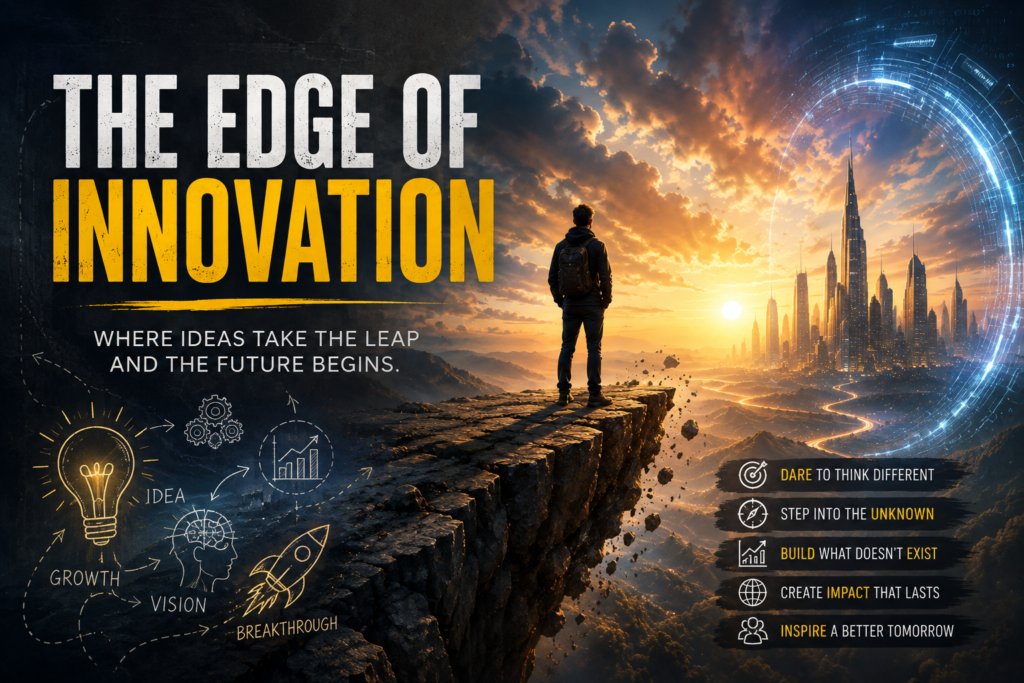
Innovation Begins Where Comfort Ends
Progress Has Never Been Comfortable
Throughout history, the world’s greatest breakthroughs have rarely come from people who were content with the status quo. Every invention, every scientific discovery, and every revolutionary business idea began with someone who dared to step beyond what was familiar.
When the Wright brothers pursued the dream of human flight, many believed it was impossible. When early computer pioneers imagined a future where every home would have a personal computer, the idea seemed unrealistic. More recently, entrepreneurs have transformed transportation, communication, healthcare, and finance by questioning long-held assumptions and challenging conventional thinking.
What connects these innovators is not extraordinary luck or unlimited resources. It is their willingness to leave behind comfort in pursuit of possibility.
Comfort offers safety and predictability, but innovation demands curiosity, courage, and a readiness to embrace uncertainty. The moment we stop accepting “the way things have always been” and begin asking, “what if there is a way better?” is the moment innovation begins.
In an era defined by rapid technological advancement, shifting markets, and evolving consumer expectations, the ability to innovate is no longer reserved for scientists or technology companies. It is becoming an essential skills for students, entrepreneurs, professionals, and organizations alike. Those who embrace change will shape the future, while those who resist it risk being left behind.
The Comfort Zone: A Silent Barrier to Innovation
A comfort zone is a place where routines feel familiar, risks are minimal, and outcomes are predictable. While this environment can provide stability, it can also limit creativity and growth.
Naturally, people prefer certainty because it feels safe. Businesses often stick with proven strategies because they have worked in the past. However, history repeatedly shows that today’s successful approach may not be enough for tomorrow’s challenges.
Many once-dominant companies struggled because they became too comfortable with their success. They assumed customers would always want the same products and services, while competitors introduced fresh ideas and better solutions. Innovation rewards those who remain adaptable, not those who become complacent.
True progress begins when individuals and organizations are willing to question existing methods and explore new possibilities.
Innovation Is More Than Technology
When people hear the word “innovation,” they often think of artificial intelligence, robotics, or cutting-edge gadgets. While technology plays a scientific role, innovation is more broader than that.
Innovation simply means creating value through new ideas, better processes, improved products, or creative solutions to existing problems.
A teacher who develops a more engaging way to educate students is innovating.
A farmer who adapts modern irrigation techniques to improve crop yields is innovating.
A small business owner who simplifies customer service through digital tools is innovating.
Innovation is not defined by complexity—it is defined by improvement.
It exists wherever people refuse to settle for mediocrity and instead search for better ways to serve others.
Why Growth Requires Discomfort
Growth and comfort rarely coexist.
Learning a new skill feels challenging because it pushes the brain beyond familiar patterns. Starting a business involves uncertainty because success is never guaranteed. Launching a new product means accepting the possibility of failure.
These uncomfortable moments are precisely where Innovation takes root.
Every successful entrepreneur has faced rejection.
Every inventor has encountered setbacks.
Every groundbreaking idea has been questioned at some point.
Discomfort is not a sign that you are moving in the wrong direction. Often, it is evidence that you are growing.
Those who achieve extraordinary results understand that temporary discomfort is the price of long-term progress.
Curiosity: The Starting Point of Every Innovation
Innovation begins with curiosity.
Curious people notice problems that others ignore.They ask questions instead of accepting assumptions. Rather than complaining about inconveniences, they wonder whether a better solution exist.
Simple questions often spark remarkable ideas.
- Why is this product so expensive?
- Why does this process take so long?
- Why can’t this be simpler?
- What would make this experience better?
Many of today’s most successful startups were born from these types of questions.
Innovation does not always require recovering something entirely new. Sometimes it involves improving something that already exists.
Technology Has Lowered the Barrier to Innovation
One of the greatest advantages of living in today’s digital age is the innovation has become more accessible.
Years ago, launching a company often required significant financial resources, expensive equipment, and large teams.
Today, a laptop and an Internet connection can be enough to build an application, launch a online business, design digital products or reach customers across the globe.
Cloud computing allows startups to scale without massive infrastructure costs.
Artificial intelligence helps automate repetitive tasks.
No-code platforms enable people without programming experience to build websites and applications.
Digital marketplace connect entrepreneurs with global audiences.
Technology has democratized innovation, making it possible for anyone with determination and creativity to turn ideas into reality.
Failure: The Hidden Partner of Innovation
One reason many people never innovate is their fear of failure.
They worry about making mistakes, being criticized, or investing time in ideas that may not succeed.
However, failure is not the opposite of innovation—it is part of the innovation process.
Many of the world’s greatest inventors experienced repeated setbacks before achieving success.
Experiments fail.
Prototypes break.
Businesses pivot.
Products improve after customer feedback.
Each failure provides valuable information that moves innovators closer to better solutions.
The goal is not to avoid failure but to learn and move on from it.
Innovation rewards persistence more than perfection.
The Role of Innovation in Business
Modern businesses operate in an increasingly competitive environment.
Consumer expectations change rapidly.
Technology evolves continuously.
New competitors emerge every year.
Companies that remain innovative are better positioned to respond to these changes.
Innovation enables businesses to:
- Improve customer experiences.
- Reduce operational costs.
- Increase productivity.
- Develop new products and services.
- Stay ahead of competitors.
- Create long-term growth opportunities.
Organizations that encourage creativity, experimentation, and continuous learning are often the ones that remain successful for decades.
Innovation Starts with Solving Problems
Every successful innovation solves problem.
Ride-sharing platforms addressed transportation challenges.
Online payment systems simplified financial transactions.
Food delivery apps made ordering meals more convenient.
Video conferencing transformed remote communication.
Behind every successful innovation lies a simple truth: someone noticed a problem and came up with a solution to solve it.
This mindset is available to everyone.
Instead of asking, “what business should I start?” consider asking, “what Problem needs solving?”
The answer may lead to your greatest opportunity.
Building an Innovative Mindset
Innovation is less about talent and more about mindset.
People who consistently innovate tend to share several habits:
- They remain curious.
- They welcome feedback.
- They embrace lifelong learning.
- They are comfortable experimenting.
- They adapt quickly to change.
- They focus on solving real problems.
- They collaborate with others.
- They persist through setbacks.
These qualities can be developed over time through deliberate practice and continuous improvement.
Innovation is not reserved for a select few—it is a skill that anyone can cultivate.
Looking Ahead
The future will continue to reward people who are willing to think differently.
As artificial intelligence, automation, renewable energy, biotechnology, and digital transformation reshape industries, entirely new opportunities will emerge.
Many of tomorrow’s most successful businesses have not yet be founded.
Many future careers do not yet exist.
The innovators who create them will be those who embrace uncertainty rather than fear it.
They will be individuals who see change not as disruption but as possibility.
Conclusion: Beyond the Comfort Zone Lies Opportunity
Comfort offers security, but it rarely creates transformation.
Every meaningful innovation begins with someone willing to leave the familiar behind, challenge existing ideas, and pursue a better solution. Whether you are a student, entrepreneur, business leader, or technology enthusiast, your ability to grow will defend on your willingness to embrace discomfort.
The best breakthrough does not require extraordinary circumstances. It begins with observing the world around you, questioning what could be improved, and have the courage to act on your ideas.
Innovation is not born in places where everything stays the same. It thrives where curiosity overcomes fear, where determination outweighs doubt, and where people choose progress over complacency.
The future will not be shaped by those who remain comfortable—it will be shaped by those bold enough to step beyond comfort and build what comes next.