

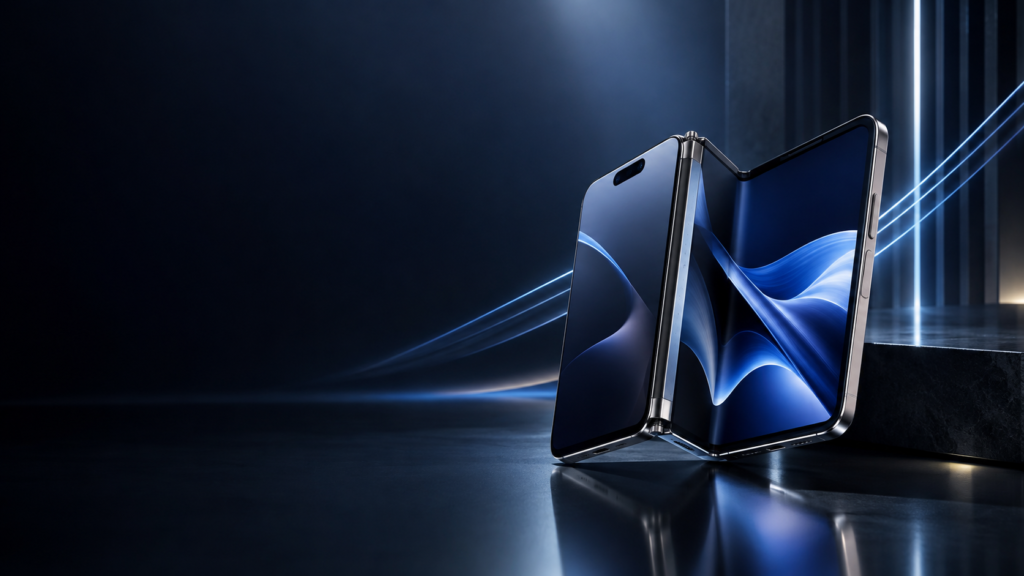
 The iPhone That Folds: Everything You Need to Know About the iPhone Duo
The first thing you notice about the iPhone Duo is not what it can do.
It is what it becomes.
Closed, it looks like a phone you could slip into your pocket and forget about. Open it, and suddenly there is a much larger screen staring back at you—almost as if the phone has quietly turned into something else.
That simple movement raises an interesting question:
Did Apple simply make an iPhone that folds, or did it finally find a reason for an iPhone to fold?
For years, foldable smartphones have existed on the edges of the mobile world. Other manufacturers experimented with hinges, flexible displays and phones that could transform into tablets. Apple watched from the side-lines.
Now, that has changed.
With the iPhone Duo, Apple has finally entered the foldable era and it is not treating the device as just another iPhone with a flexible screen. The Duo is an attempt to rethink how we use the iPhone when one screen is not enough.
One iPhone, Two Experiences
The idea behind the Duo is surprisingly simple.
When closed, the phone has a 5.4-inch Super Retina XDR display. It is designed for the quick things we do dozens of times a day: checking messages, browsing, answering calls, looking at notifications or taking a quick photo.
Open the phone, however, and that compact experience expands into a 7.6-inch inner display.
That makes the Duo feel less like a traditional smartphone and more like a miniature tablet.
And this is where Apple’s foldable experiment becomes interesting.
The larger screen is not simply there to make videos look bigger. Apple has redesigned iOS 27 to make use of the extra space, including Split View, which allows two apps to appear side by side.
For someone writing an article, that could mean having research open on one side while drafting on the other.
For a student, it could mean reading a PDF while taking notes.
For a traveller, it could mean keeping a map open while checking a reservation.
Suddenly, the bigger screen has a purpose.
The Design is Impressive—But The Hinge Is Not the Whole Story
Naturally, a foldable phone lives or dies by its folding mechanism.
Apple has given the Duo a Grade 5 titanium frame and hinge cover, Ceramic Shield protection and an IP68 rating for water and dust resistance.
The inner display also uses a scratch-resistant surface and a nano-texture finish designed to reduce glare.
But perhaps the most interesting part is how Apple has approached the crease.
Foldable screens have traditionally had one unavoidable reminder that you are holding a folding device: the line running through the middle.
Apple has worked to make that crease less distracting, rather than allowing it to dominate the experience.
Still, the hinge is only the beginning.
The real question is what happens after you open the phone.
A Display that Changes the Way You Work
This is arguably where the Duo makes its strongest case.
Imagine researching a story while sitting in a café.
On an ordinary phone, you might open a browser, read something, switch to your notes, type a few sentences, return to the browser and repeat the process.
With the Duo unfolded, iOS 27’s Split View can place two apps beside each other.
The result is subtle but important.
You are not constantly moving between information.
The information comes together on the same screen.
You can even use two windows of the same application in supported situations.
That makes the Duo particularly interesting for people who use their phones for more than entertainment.
Writers, students, researchers, and professionals could potentially get more done without carrying a separate tablet.
And when you do not need all that space?
Close it.
That ability to switch between compact and expensive is perhaps the Duo’s biggest idea.
The Camera Gets Some Clever Tricks
Apple has not ignored photography either.
The Duo features a 48MP Fusion Main camera and a 48MP Fusion Ultra Wide camera, alongside a 12MP Center Stage front camera.
But the more interesting camera features comes from the folding design itself.
Take Duo Preview.
When someone is taking your picture, the outer display can show a preview of the shot, allowing the person in front of the camera to see how they are positioned.
That could make group photographs considerably easier.
Then there is Smart Take, which uses on-device AI to analyse the scene and capture the moment when people appear ready.
There is even Kid Cue, which uses animated elements to help attract a child’s attention towards the camera.
These may sound like small additions, but they reveal something clever about Apple’s approach.
The company is not simply asking, “How do we put cameras on a foldable phone?”
It is asking:
“What can a folding phone let the camera do differently”
The AI Inside the Duo is Doing More Than Taking Pictures
The Duo is powered by Apple’s A20 Pro chip, which includes a Dual 16-core Neutral Engine for demanding AI workloads.
Apple says the chip offers up to 20 percent faster CPU performance than the previous generation’s A19 pro and up to 50 percent more memory bandwidth.
But numbers alone do not make a phone interesting.
What matters is how that power affects everyday use.
AI is increasingly becoming part of the smartphone experience—from photography and image processing to personal assistance and understanding what users are doing.
On the Duo, those capabilities are paired with a much larger display.
That combination could make AI features feel less like isolated tools and more like something integrated into the way you work.
The Battery Has a Difficult Job
A foldable phone has an obvious challenge.
It has more screen to power, but it still needs to remain thin enough to fold comfortably.
Apple tackles this with a dual-battery system.
According to Apple, the Duo can deliver up to 31 hours of video playback on the inner display and up to 44 hours using the outer display.
It can also reach 50 percent charge in around 20 minutes with fast wired charging.
Those figures will ultimately need real-world testing to tell the full story, but Apple clearly understands that a beautiful foldable screen means very little if the battery cannot keep up.
And Then Comes an Unexpected Return: Touch ID
There is another detail that may surprise longtime iPhone users.
The Duo does not use Face ID.
Instead, Apple has brought back Touch ID, integrated into the side button.
That is a notable departure from recent iPhones.
The decision also makes practical sense for a foldable device because authentication works whether the phone is open or closed.
Still, for people who have grown accustomed to simply looking to unlock it, Touch ID may take some getting used to.
The Duo Can Also Become a Creative Tool
Apple is planning support for Apple Pencil with USB-C later in 2026.
That might sound like a small feature until you consider what the Duo actually is.
A phone that unfolds into a 7.6-inch display and supports a stylus starts moving into territory traditionally occupied by tablets.
A writer could annotate documents.
A student could take handwritten notes.
A designer could sketch an idea.
Someone planning a project could quickly draw a diagram without reaching for another device.
The line between smartphone and tablet becomes increasingly different to see.
And perhaps that is exactly what Apple wants.
But Should Everyone Buy One?
Probably not.
That is an important part of the conversation.
The iPhone Duo starts at $1,999, making it one of Apple’s most expensive iPhones.
For someone who mainly makes calls, sends messages, scrolls through social media and takes everyday photographs, a conventional iPhone may already be more than enough.
There are also compromises.
The Duo uses Touch ID rather than Face ID. It’s camera system does not offer the same dedicated telephoto approach found on some traditional pro models. And while the folding screen provides considerably more space, not everyone will find that extra room worth paying for.
A foldable phone is not automatically better simply because it can fold.
The question is whether you have a reason to unfold it.
So, What Makes the iPhone Duo Important?
The answer may have less to do with specifications than with what the device represents.
For years, smartphones followed a remarkably predictable formula.
Make the screen better.
Make the processor faster.
Make the camera sharper.
Make the body thinner.
Then repeat.
The Duo changes one of those assumptions.
It asks what happens when the smartphone doesn’t have to remain one size all the time.
Closed, it is convenient.
Open, it becomes a workspace.
And that flexibility could be its most important feature.
The Beginning of a Different Kind of iPhone
The iPhone Duo may not convince everyone that foldable phones are necessary.
It does not need to.
Its arrival matters because Apple has finally joined a conversation that other smartphone makers started years ago.
The company has taken the familiar iPhone and given it another form.
And perhaps that is what makes the Duo so fascinating.
Technology often changes quietly. Sometimes it happens through a faster chip or a better camera. Other times, it happens because a familiar object suddenly behaves differently in your hands.
The Duo belongs to the second category.
You close it, and it is an iPhone.
You open it, and it asks you to imagine what an iPhone could become.
Maybe that is the real beginning of Apple’s foldable era—not the moment the screen bends, but the moment we start wondering what else our phones could become when we stop assuming they have to stay the same shape.