

 How Does the Internet Connect Countries Separated by Oceans?
Imagine sending a WhatsApp message from Lagos to a friend in New York. You tap the send button, and within seconds, your friend receives it. You can even make a video call, share photographs, or watch the same video from opposite sides of the Atlantic Ocean.
But have you ever wondered how that message gets there?
Does it travel through satellites floating in space? Does it pass through invisible signals crossing the ocean? Or is there something happening beneath the water that most internet users never think about?
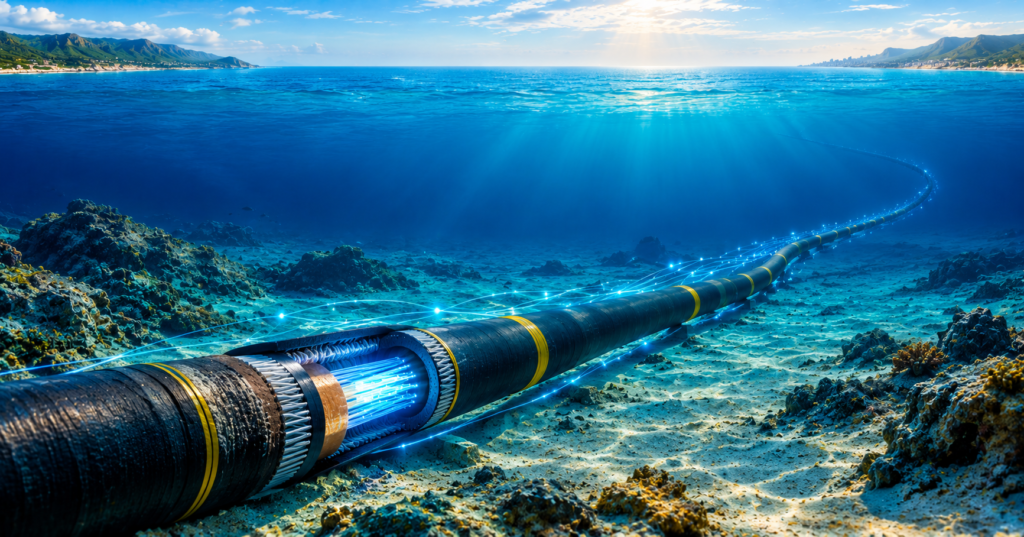
The answer is fascinating. Much of the world’s international internet traffic travels through submarine fibre-optic cables laid across the ocean floor. These cables connect continents, carry enormous amounts of digital information, and help make our connected world possible.
Beneath the waves lies an extraordinary network that keeps the modern internet alive.
The Internet Has a Hidden Highway Beneath the Ocean
When people think about the internet, they often picture Wi-Fi signals, smartphones, laptops, and satellites. However, the internet is not simply a cloud of invisible information floating around the planet.
It is a physical system made up of computers, routes, data centres, communication equipment, and kilometres upon kilometres of cables.
Some of these cables run underground across cities and countries. Others stretch across the seabed, connecting places separated by thousands of kilometres of water.
These are known as submarine communication cables.
Inside many of them are extremely thin strands of glass called optic fibres. Rather than sending information as ordinary electrical signals along copper wires, these fibres transmit data using pulses of light.
Think of each pulse as part of a message written in a language computers understand. By sending carefully controlled patterns of light, the system can transmit information at extraordinary speeds.
And because light travels through the fibres with very little signal loss, enormous amounts of data can move across continents efficiently.
The surprising part? Some of the most important highways of the internet are hidden where almost nobody can see them.
What Happens When You Send a Message Across the Ocean?
Let us return to that message from Lagos to New York.
You type, “How was your day?” and press send.
Your phone does not launch the message directly across the Atlantic. Instead, the information begins a journey through several connected networks.
First, your phone sends the data over Wi-Fi or a mobile network. From there, it travels through your internet service provider’s network and other connected systems.
Depending on the app, network arrangement, and where its servers are located, the message may pass through data centres or other infrastructure before reaching its destination.
If the route requires communication between continents, the data can travel through terrestrial fibre-optic cables to a coastal landing station, where an international submarine cable connects to the wider network.
At the other end of the ocean, the cable reaches another landing station. From there, the information continues through networks until it reaches the destination device or the service delivering the message.
All of this happens so quickly that you rarely have time to think about it.
There is no single universal route followed by every message. Internet traffic takes different paths depending on network design, available connections, congestion, and other technical factors.
But the central idea remains the same: Your digital message depends on real physical infrastructure to travel between distant places.
How Can a Cable Survive at the Bottom of the Ocean?
Here is where the story becomes even more interesting.
The ocean is not a gentle environment for delicate technology. It contains deep trenches, shifting seabeds, powerful currents, fishing activity, and equipment from ships that can accidentally damage cables.
So how do engineers protect a cable carrying so much important information?
The answer depends on where the cable is located.
Near coastlines and in shallower waters, submarine cables are often buried beneath the seabed or protected with additional layers of armour. These areas face greater risks from anchors, fishing equipment, and human activity.
In deeper water, cables can often be lighter and less heavily armoured because some of those risks are reduced. Their construction is designed for the conditions in which they will operate.
Despite their protective design, these cables are not indestructible. Undersea earthquakes, underwater landslides, ship anchors, and fishing equipment can damage them.
When a cable breaks, engineers must locate the fault, send a specialized repair ship, recover the affected section, and repair or replace the damaged part.
Imagine trying to fix a tiny section of cable in the middle of an ocean. It is an expensive, technically demanding operation that can take time.
Yet these repairs are essential because a damaged cable can disrupt internet connections for entire regions, especially when alternative routes are limited.
Who Puts Internet Cables in the Ocean Floor?
Submarine cables do not appear underwater by magic. Specialized cable-laying ships carry enormous amounts of cable and carefully deploy it along planned routes.
Before the cable is laid, engineers survey the seabed to identify suitable paths and avoid hazards wherever possible.
During installation, the ship moves along the route while controlled equipment lowers the cable into the water. In some shallow areas, specialized tools bury it beneath the seabed for protection.
A single cable system can extend for thousands of kilometres and require multiple landing stations along its route.
These stations connect the undersea system to networks on land. They contain equipment that helps manage the transmission of information and connect the cable to other parts of the internet.
The project involves telecommunication companies, infrastructure investors, engineers, marine specialists, and governments or regulators.
It is a massive undertaking, but it creates a connection that can carry data for many years.
What About Satellites? Can’t They Do the Same Job?
You might be wondering why the internet cannot simply travel through satellites instead.
Satellites are certainly important. They provide internet access to remote communities, ships, aircraft, and locations where building terrestrial infrastructure is difficult.
Satellite Internet can be especially valuable where conventional networks are unavailable or unreliable.
However, submarine fibre-optic cables remain essential for carrying large volumes of international Internet traffic.
They can provide very high capacity, and many routes offer low latency compared with traditional geostationary satellite connections.
Latency is the time it takes for data to travel between two points. Even though fibre-optic signals travel extremely fast, they still need time to cover thousands of kilometres.
Low Earth orbit satellite systems can offer much lower latency than traditional geostationary satellites, so the comparison depends on the technology and route involved.
Still, satellites and undersea cables are not competing solutions that must replace each other. They serve different purposes and can complement one another.
Why These Cables Matter to Nigeria and Africa
The story becomes particularly relevant when we consider Africa’s connection to the rest of the world.
Countries across the continent depend on international connectivity for online banking, remote work, cloud computing, education, video streaming, business communications, and many other services.
Submarine cables connect coastal landing stations to international networks, including routes linking African countries with Europe, the Middle East, and other regions.
Nigeria, for instance, has submarine cable landing infrastructure along its coast. These connections help carry international data traffic used by businesses, internet providers, and everyday users.
But an important distinction exists: an undersea cable does not automatically guarantee fast internet in every home.
After data reaches a country, it still needs to travel through domestic networks. The quality of the final connection also depends on local fibre infrastructure, mobile network capacity, electricity, internet service providers, congestion, and the device being used.
This explains why someone living near a major cable landing station can still experience slow internet.
The international highway may be working perfectly, while a problem exists somewhere along the local road leading to the user’s phone.
What Happens When an Undersea Cable Breaks?
When a submarine cable is damaged, traffic may be redirected through other available cables and network routes.
If sufficient alternative capacity exists, many users may notice little or no disruption. In other situations, internet speeds can drop, latency can increase, and some services may become difficult to access.
The impact depends on which cables are affected, how networks are connected, and how much spare capacity is available.
This is why countries and telecommunications companies benefit from having multiple international connections rather than depending on a single route.
Redundancy is the technical term for having alternative systems available when one fails.
It is similar to having more than one road connecting two cities. If one road closes, drivers can use another route, although the alternative may be longer or more crowded.
The same principle helps make the Internet more resilient.
The Ocean Is Not Between Us Anymore
The next time you send a photograph to a friend overseas, join an international video meeting, or stream a video created on another continent, remember what may be happening beneath the water.
Your information could be traveling through a network of glass fibres resting on the ocean floor, carried as pulses of light through infrastructure designed and maintained by people working across the world.
The Internet may feel invisible, but the system supporting it is anything but imaginary.
It is built from ships, cables, landing stations, data centres, engineers, and countless interconnected networks.
And perhaps that is the most surprising lesson of all: a technology that makes the world feel smaller depends on some of the largest and most engineering projects ever built.
The ocean still separates continents geographically. Underneath it, however, a remarkable network helps bring their people, businesses, and ideas closer together