
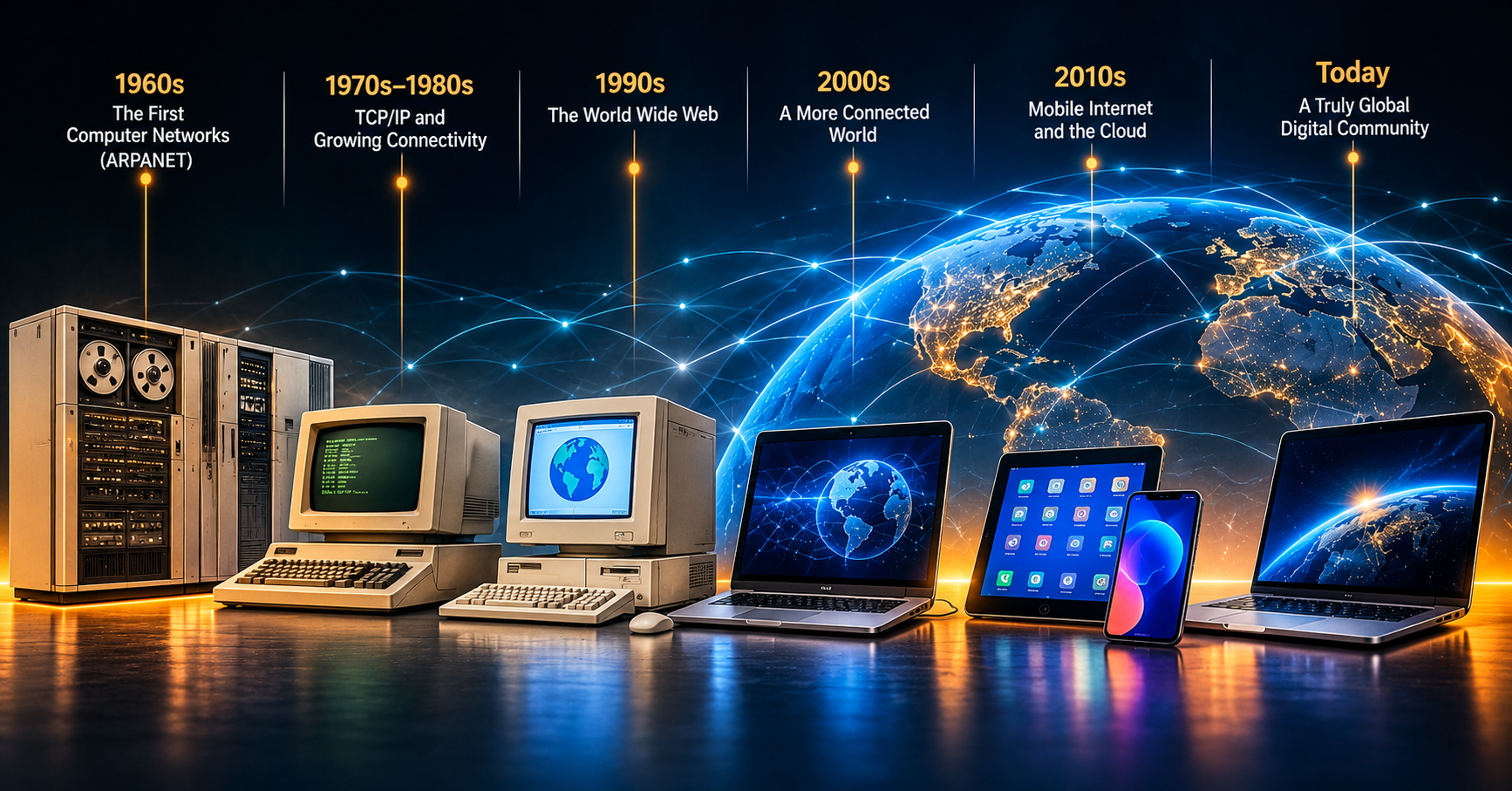
 The History of the Internet: How a Military Experiment Changed the World
Before smartphones, Google searches, social media and online banking, communicating information across distant locations was a much slower process. People depended on letters, telephone calls, newspapers, radio broadcasts and physical documents to exchange information.
Computers existed, but connecting them so they could communicate with one another over long distances was a different challenge.
Today, someone in China can send a message to a friend in London within seconds, attend an online lecture hosted in another country, transfer money digitally or access information stored on a computer thousands of kilometres away.
This level of connectivity did not happen overnight.
The internet developed through decades of research, experimentation and technological breakthroughs. What began as an ambitious computer networking experiment eventually became one of the most influential inventions in human history.
Its story stretches from military-funded research laboratories in the United States to the interconnected digital world we depend on today.
The World Before the Internet Communication Was a Different Experience
Long before the internet became part of everyday life, information travelled through physical and electronic communication systems.
People wrote letters and waited days or weeks for replies. Newspapers distributed information to large audiences, while radio and television brought news and entertainment into homes.
The telephone made direct conversations possible across long distances, but it did not provide the ability to exchange digital documents, search enormous collections of information or connect thousands of computers.
Computers were also very different from the machines we use today.
During the 1950s and 1960s, computers were expensive, enormous machines commonly found in government departments, universities, research institutions and large organizations.
Many operated independently. If a researcher wanted information stored on another computer, accessing it could involve complicated procedures or physically transferring data.
This created an important question:
What if computers in different locations could communicate directly and share information without requiring people to move data manually?
That question helped inspire the development of computer networking.
The Original Problem: Why Researchers Wanted Computers to Communicate
During the 1960s, the United States invested heavily in scientific research and computing.
The Advanced Research Projects Agency (ARPA), established in 1958 within the United States Department of Defense, supported research into advanced technologies.
Researchers were increasingly interested in connecting computers located at different universities and research centres.
The challenge was not simply creating a communication link between two machines. They needed a reliable method that could allow different computers to exchange information even when they used different systems.
There was also an economic consideration.
Computers were expensive resources. Allowing researchers in different institutions to access computing facilities remotely could make those resources more useful.
Another important concern was communication reliability. Researchers wanted networks that could continue carrying information even when individual connections became unavailable.
This encouraged interest in packet switching, an approach that would become one of the foundations of modern computer networking.
The Early Experiments: ARPANET and Its First Connection in 1969
One of the most important milestones in internet history was the development of ARPANET.
ARPANET stands for Advanced Research Projects Agency Network. It was developed through research supported by APRA and became an early demonstration of computers communicating across a network.
In 1969, four institutions became the first nodes of this experimental network:
- University of California, Los Angeles (UCLA).
- Stanford Research Institute (SRI).
- University of California, Santa Barbara.
- University of Utah.
On October 29, 1969, researchers attempted to send a message from UCLA to a computer at Stanford Research Institute.
The intended word was LOGIN.
But something unexpected happened.
The receiving computer crashed after accepting only the first two letters: LO.
Although the first attempt failed, the researchers had successfully transmitted those two characters between distant computers.
They eventually completed the LOGIN transmission.
It was a modest beginning, but it demonstrated something extraordinary: computers in different locations could communicate through a network.
ARPANET gradually expanded, connecting more research institutions and supporting new forms of digital communication.
It was not yet the global internet, but it had established an important foundation.
4. The Breakthrough: Packet Switching and the Development of TCP/IP
One of the most important ideas in the development of the Internet was packet switching.
To understand why it matters, consider sending a large document to someone in another country.
Instead of transporting the entire document as one continuous block, packet switching divides the information into smaller units called packets.
Each packet carries a portion of the original information, together with addressing and control information that helps it reach its destination.
The packets can travel through different available routes before being assembled into the original message at the receiving end.
This approach makes communication more flexible and efficient.
It also means that a network does not have to depend on one continuous connection between two computers.
Packet switching became a fundamental part of APRANET and the wider development of computer networking.
The arrival of TCP/IP
Another major breakthrough came through the work of computer scientists Robert Kahn and Vinton Cerf.
They helped develop Transmission Control Protocol (TCP) and Internet Protocol (IP), commonly known together as TCP/IP.
These protocols provided a common method for computers and different networks to exchange information.
Their responsibilities can be understood simply:
- IP: Handles addressing and helps direct packets towards their destinations.
- TCP: Helps organise data transmission and ensures that information can be reassembled correctly, with missing data retransmitted when necessary.
This development was particularly important because researchers wanted different computer networks to communicate rather than remain isolated systems.
On January 1, 1983, ARPANET officially transitioned to TCP/IP.
This milestone helped establish the technical foundation of the modern internet: a network capable of connecting other networks.
The Internet did not become powerful simply because computers could communicate. Its real potential emerged when different networks could communicate using common rules.
The World Wide Web: Tim Berners-Lee’s Contribution
By the late 1980s, computer networking had advanced considerably. Researchers could exchange information across interconnected networks, but finding and organising information across different computers was still complicated.
This was the problem British computer scientists Tim Berners-Lee wanted to address.
While working at CERN, the European organization for Nuclear Research, he proposed a system that would make it easier for researchers to access and share information.
In March 1989, he submitted his first proposal for what would eventually become the World Wide Web.
Working with Belgian systems engineer Robert Cailliau, he developed the proposal further.
By the end of 1990, Berners-Lee had created the essential components of the early Web:
- HTML (HyperText Markup Language), used to structure web pages.
- HTTP (HyperText Transfer Protocol), used to transfer information between web clients and servers.
- URLs (Uniform Resource Locators), used to identify and locate resources on the Web.
- A web browser and a web server.
The first website was hosted at CERN under the address info.cern.ch.
Its purpose was to explain the World Wide Web project itself.
In August 1991, Berners-Lee made the Web project available to a wider Internet community. A particularly important decision followed on April 30, 1993, when CERN released the Web software into the public domain.
This encouraged developers around the world to use and improve the technology.
The Internet and the World Wide Web are not the same
The distinction is worth understanding.
The internet is the global system of interconnected computer networks.
The World Wide Web is a service that operates on the internet, allowing people to access connected documents, websites and other resources through browsers.
Think of the Internet as a transportation network and the Web as one of the services that uses it.
Email, online gaming, file transfers and other internet services do not depend on the Web in exactly the same way websites do.
The distinction explains why the internet existed before the World Wide Web was invented.
The Commercial Revolution: How the Internet Reached Ordinary People
For many years, internet access was largely associated with universities, government research institutions and scientific organizations.
That gradually changed during the 1990s.
The development of graphical web browsers made the Web easier to use. One particularly influential example was Mosaic, released by the National Center for Supercomputing Applications in 1993.
Unlike earlier browsing experiences, Mosaic helped make websites more visually accessible to ordinary computer users.
Businesses also began recognising the internet’s commercial possibilities.
Companies started establishing websites, publishing product information and exploring ways to reach customers online.
The expansion of internet service providers made it possible for households and businesses to connect through telephone lines using dial-up connections.
Users could browse websites, exchange emails, participate in online discussion groups and download files.
The Internet was becoming a commercial environment rather than a network used mainly by researchers.
Another major milestone occurred in 1995 when the National Science Foundation’s NSFNET backbone was decommissioned as commercial networks increasingly took over the provision of internet connectivity.
This transition helped accelerate the growth of privately operated internet infrastructure.
A technology becomes truly transformative when its usefulness extends beyond the people who originally developed it.
The Modern Era: Broadband, Smartphones and Cloud Computing
The internet continued evolving throughout the 2000s and beyond.
Three developments were particularly influential.
Broadband changed internet speed
Dial-up connections were slow and often occupied the telephone line while users were online.
Broadband technologies, including DSL and cable internet, provided faster and more convenient access.
This made activities such as streaming video, downloading large files and using interactive websites more practical.
Later, fibre-optic networks increased connection speeds further.
Smartphones made the internet portable
The arrival of modern smartphones changed how people accessed the internet.
Instead of depending on desktop computers, users could browse websites, communicate, watch videos, make payments and access online services from handheld devices.
Mobile networks, including 3G, 4G, and 5G expanded the possibilities of internet access.
In countries such as Nigeria, smartphones have become an important gateway to digital services, particularly for people who rely more on mobile devices than desktop computers.
Cloud computing changed where information lives
Another important development was cloud computing.
Previously, individuals and organizations often depended heavily on computers and physical storage devices to keep their files and applications.
Cloud computing made it possible to access computing resources, applications and stored information through internet-connected services.
Businesses could host websites, store customer information, operate digital platforms and manage applications without maintaining all the necessary infrastructure themselves.
Today, cloud services support online banking, streaming platforms, artificial intelligence, remote working and countless other digital activities.
The internet has consequently become much more than a communication tool. It is now an essential foundation for modern economic and social activity.
The Historical Lesson: How an Experiment Became Essential Infrastructure
The history of the internet reveals an important lesson about technological innovation.
Major inventions do not always begin with the enormous influence they eventually acquire.
ARPANET was developed to address research and computer communication challenges. Tim Berners-Lee wanted to make information sharing easier for researchers. Early browser developers wanted to make online information more accessible.
None of these developments initially represented the full range of activities the modern internet would support.
Yet each breakthrough created opportunities for further innovation.
Today, people use internet connectivity to run businesses, attend online classes, access financial services, publish research, communicate with loved ones and build careers.
A small retailer can receive payments digitally, advertise products through social media and reach customers in other countries without establishing a physical office in those locations.
A student can access educational materials published by universities thousands of kilometres away.
A software developer can build an application using cloud infrastructure provided by companies operating across different continents.
These possibilities are connected to decades of research and technological development.
The internet also continues to face challenges involving cybersecurity, misinformation, privacy, unequal access and infrastructure costs. Its history is therefore not simply a story of technological success. It is also a reminder that every major innovation creates new responsibilities.
Final Thoughts
The internet began as an experimental approach to connecting computers. Over time, researchers developed common communication protocols, innovators created the World Wide Web, businesses introduced commercial services and telecommunications companies expanded access.
What emerged was a global network that changed how humanity communicates, learns, works and conducts business.
Perhaps the most fascinating part of its history is that something initially designed to solve a relatively specific technical problem became infrastructure used by billions of people.
The internet is a powerful example of how an idea can grow beyond its original purpose and reshape the world.