

 What Does a GaN Charger Do, and Is It Worth Buying?
For years, charging technology followed a familiar pattern: the more powerful the charger, the larger and heavier the charging brick seemed to become. Laptop chargers occupied valuable space in travel bags, phone adapters competed for sockets, and carrying several chargers became part of owning multiple electronic devices.
Then a different semiconductor material began changing the design of these everyday accessories.
It is called Gallium Nitride (GaN), and it is making it possible to produce powerful chargers without necessity making them bulky.
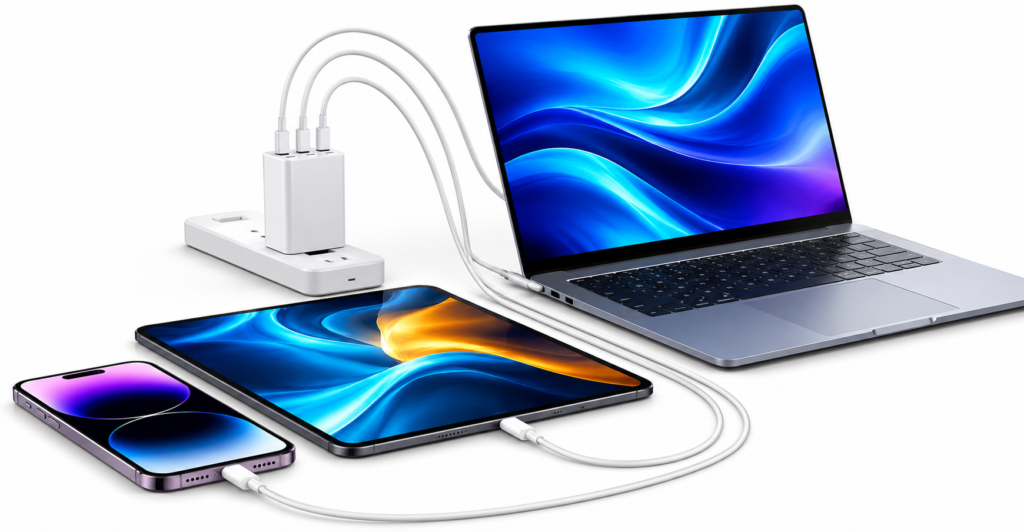
A charger that once required considerable physical space can now fit into a much smaller adapter. Some models can even power a laptop, smartphone and tablet for a single charging unit.
But is this genuinely an improvement in charging technology, or simply another expensive accessory with an attractive specification?
Understanding what happens inside a GaN charger reveals why this relatively small piece of equipment represents an important development in modern electronics.
What Is a GaN Charger?
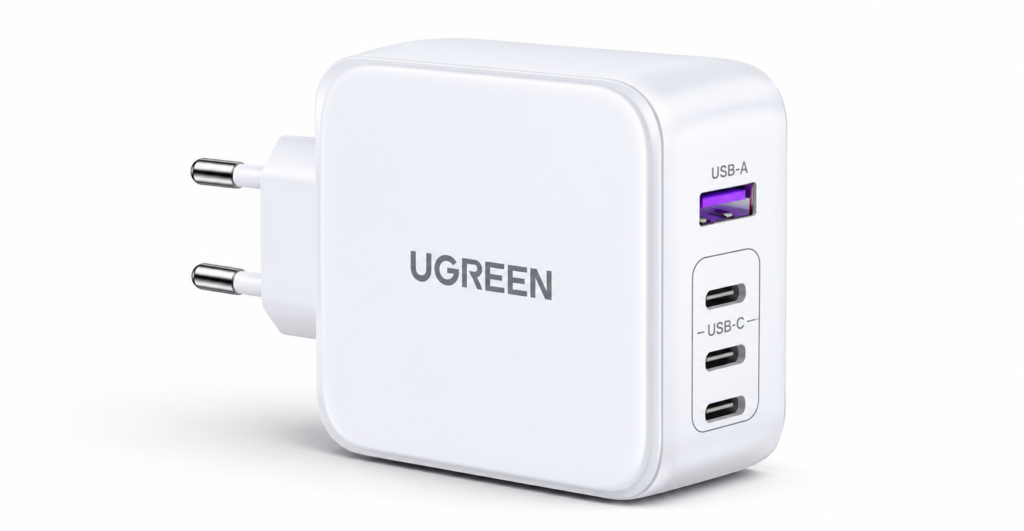 A GaN Charger is a power adapter that uses a semiconductor material called gallium nitride in its internal electrical components instead of relying entirely on traditional silicon-based components.
To understand its purpose, consider what an ordinary charger does.
Electricity supplied by a wall socket is alternating current (AC), while smartphones, laptops and tablets require direct current (DC) to operate and recharge their batteries.
A charger converts electricity from the socket into a form that electronic devices can safely use.
The interesting part is the material responsible for controlling this conversion.
Traditional chargers commonly use silicon transistors. GaN chargers use gallium nitride transistors, which can switch electrical power more efficiently at high frequencies.
This allows manufacturers to reduce the size of certain internal components without sacrificing the chargers ability to deliver substantial power.
The important distinction: GaN does not replace the entire charging system. It improves the semiconductor technology used to manage electrical power.
Gallium nitride is not an entirely new discovery. It has also been used in applications such as LED lighting and specialized electronic systems. Its growing adoption in power electronics has made compact, high-output charging equipment more practical.
What Problem Does a GaN Charger Solve?
The problem is not simply that traditional chargers are unattractive or inconvenient. It is the engineering challenge of delivering increasing amounts of electrical power within limited physical space.
As electronic devices became more powerful, their charging requirements increased.
A laptop might require considerably more power than a basic smartphone. Charging several devices simultaneously creates an additional demand on the adapter.
Traditional silicon-based designs can experience greater switching losses as operating frequencies increase. Some electrical energy is lost as heat, and that heat must be managed through the charger’s design.
This creates a difficult balancing act:
- Deliver more electrical power.
- Control unnecessary energy losses.
- Prevent excessive heat.
- Keep the equipment reasonably compact.
GaN technology helps address these competing requirements.
By reducing certain switching losses and allowing higher operating frequencies, gallium nitride makes it possible to use smaller transformers and other internal components.
The result is a new generation of compact, high-power adapters.
The real innovation is not simply faster charging. It is ability to deliver considerable electrical power from a surprisingly small device.
How Does a GaN Charger Work?
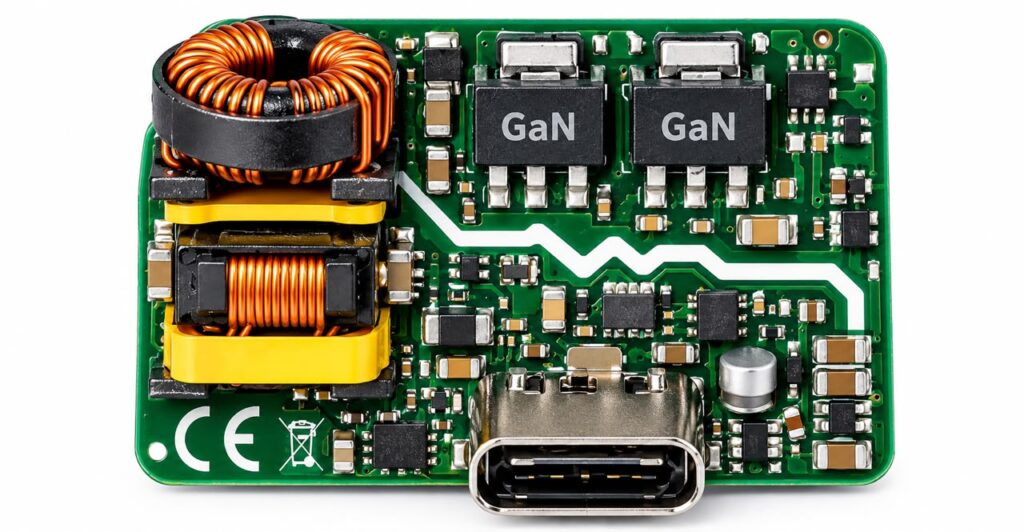 The operating principle becomes easier to understand when you follow the movement of electricity.
A GaN charger performs several electrical operations before power reaches your phone or laptop.
1. Electricity enters the charger
When plugged into a wall socket, the charger receives alternating current (AC).
2. The current is converted
Internal rectification and power-conversion circuits transform the incoming electricity into controlled direct current (DC).
3. GaN transistors regulate the conversion
This is where the gallium nitride technology becomes important.
The transistors rapidly switch electrical current on and off, controlling how power moves through the circuit.
Because GaN transistors can switch at higher frequencies with relatively low losses, engineers can design smaller and more efficient power-conversion systems.
4. The charger delivers suitable power
The charger regulates its output according to its design and the charging requirements communicated by a compatible device.
For USB-C chargers, technologies such as USB Power Delivery (USB PD) allow the charger and connected device to negotiate an appropriate voltage and power level.
Think of GaN as the improved engine inside the charging equipment. USB Power Delivery is part of the communication system that helps determine how much power the connected device receives.
This distinction matters because GaN technology alone does not determine charging speed. The charger’s wattage, charging protocol, cable and device compatibility all influence performance.
What Are the Uses of GaN Chargers?
The most visible application is consumer electronics, but the wider GaN semiconductor technology has applications across several industries.
1. Smartphones and tablets
People can use compact GaN adapters to charge smartphones, tablets and other portable electronics.
Multiport models are particularly useful when several devices need power from one wall socket.
2. Laptop computers
Some GaN chargers provide enough power for compatible laptops, including certain professional and high-performance models.
A suitable 65W or 100W adapter, for instance, can replace a larger laptop charging brick when the computer supports the required charging standard.
3. Business and professional environments
Offices, educational institutions and businesses can use multiport charging equipment to reduce the number of individual adapters required for compatible devices.
4. Travel and mobile work
Freelancers, photographers, journalists and remote workers often carry several electronic devices. A compact multiport charger can reduce the equipment they need to pack.
5. Electric vehicles and industrial electronics
Beyond consumer wall chargers, GaN semiconductors are also being developed for electric vehicle power conversion, renewable energy systems, telecommunications and industrial power supplies.
These are broader applications of GaN technology, rather than necessarily the same type of USB charger sold to smartphone users.
Who Needs a GaN Charger?
Not everybody needs to replace their existing charger.
However, certain groups can benefit considerably from the technology.
- Students: Those carrying smartphones, tablets and laptops can reduce the number of charging adapters they need.
- Remote workers: People working across different locations can benefit from smaller, multi-device charging equipment.
- Business professionals: A single compatible adapter can simplify everyday office and travel arrangements.
- Content creators: Photographers, videographers and digital professionals often depend on several portable electronic devices.
- Frequent travellers: Smaller chargers take up less luggage space and reduce the weight of travel accessories.
For someone who owns one smartphone and already has a reliable charger, the difference might be relatively minor.
But for someone regularly carrying three or four electronic devices, the convenience becomes much more noticeable.
What Are the Limitations of GaN Chargers?
Despite their advantages, GaN chargers are not perfect. Their popularity can sometimes make them appear more revolutionary than they actually do.
There are several things buyers should understand before spending money.
1. They do not automatically charge devices faster
This is perhaps the biggest misconception.
A 65W GaN charger does not automatically charge a smartphone faster than a conventional 65W charger.
If both chargers support the same charging standard and deliver the same power, their charging may be similar.
2. Compatibility still matters
Not every charger works optimally with every device.
Buyers need to consider wattage, USB-C Power Delivery support, cable specifications and the manufacturer’s charging requirements.
3. Higher-quality models can be expensive
GaN chargers can cost more than basic charging adapters, particularly when they offer multiple ports, high wattage and advanced charging features.
4. Multiple devices share available power
A 100W multiport charger does not necessarily provide 100W to every connected device simultaneously.
Its available output is distributed between connected devices according to the manufacturer’s power-allocation design .
5. Small does not mean indestructible
GaN technology does not eliminate electrical faults, manufacturing defects or excessive heat. Poorly designed chargers can still present safety risks.
Buyers should choose reputable manufacturers, appropriate safety certifications and chargers with clearly stated electrical specifications.
A GaN label is not guarantee of quality. A well-designed conventional charger can be a better purchase than a poorly manufactured GaN alternative.
What Happens Without GaN Chargers?
The world would not stop charging smartphones, laptops or other electronic devices if GaN chargers disappeared.
Traditional silicon-based chargers would continue performing these functions.
In fact, silicon remains an important material in power electronics.
But, manufacturers would face greater design challenges when trying to produce increasingly compact chargers with high power outputs.
Larger adapters, additional charging accessories and less convenient travel arrangements could remain more common in certain product categories.
The wider significance of GaN becomes even clearer when looking beyond consumer electronics.
Its application in electric vehicles, renewable energy equipment, telecommunications and industrial power systems demonstrates how semiconductor improvements can influence the way electricity is converted and managed.
In other words, the importance of GaN extends beyond the small charging adapter sitting beside someone’s bed.
Is GaN Charger Worth Buying?
Yes, but whether it is worth buying depends on your charging habits.
A GaN charger makes particular sense if you:
- Regularly carry multiple electronic devices.
- Want to replace bulky laptop and smartphone adapters.
- Need a compact travel charger.
- Want a multiport adapter for compatible devices.
- Require a high-wattage charger without carrying a particularly large power brick.
Before purchasing, pay attention to these specifications:
Wattage: Match your device’s power requirements.
Charging protocol: Look for compatible USB PD or PPS support where required.
Ports: Choose the number of connections you actually need.
Cable: Ensure it supports the required power output.
Safety: Buy from a reputable manufacturer with appropriate protection features.
It is also sensible to check the chargers input-voltage range, plug compatibility and suitability for local electrical conditions.
A 65W or 100W model may be a practical option for someone charging a compatible laptop and smartphone while a smaller 30W or 45W model may be sufficient for everyday phone and tablet charging.
The important thing is not to purchase the highest wattage simply because it looks impressive.
Buy the charging capacity your devices require, not the biggest number printed on the packaging.
Ultimately, GaN chargers represent a meaningful improvement in the design of everyday electronic accessories. They make it easier to deliver substantial power from smaller equipment, reduce the need to carry several adapters and support the growing demand for portable electronics.
They are not essential for everyone, but for people who value portability, charging flexibility and efficient power conversion, they are certainly worth considering.