 What are AI agents and how are they different from chatbots?
Artificial Intelligence is moving beyond systems that simply answer questions.
For years, AI chatbots have helped people write emails, answer questions, summarize information, generate ideas, and explain complicated subjects. But a new type of AI is becoming increasingly important: AI agents.
Unlike a traditional chatbot that mainly responds to your prompts, an AI agent can be designed to understand a goal, plan multiple steps, use digital tools, make decisions, and take action.
That raises a very crucial question: what exactly is an AI agent, and how is it different from a chatbot?
The difference becomes clearer when you look at how each system works.
What Is an AI Chatbot?
An AI chatbot is a software system designed to communicate with users through natural language.
You ask a question or give it an instruction, and the chatbot generates a response. Modern AI chatbots often use large language models (LLMs) to understand language, maintain conversational context, and produce human-like responses.
For example, you might ask:
“Explain cloud computing in simple terms.”
The chatbot can provide an explanation, examples, and answers to follow-up questions.
You could also ask it to rewrite an email, summarize a document, brainstorm blog topics, translate text, or explain a technical concept.
The valid point is that a chatbot is primarily built around conversation and responding to user input.
What Can AI Chatbots Do?
Modern AI chatbots can help with many everyday tasks, including:
- Answering questions
- Writing and editing
- Summarizing documents
- Brainstorming ideas
- Learning and tutoring
- Translation
- Customer Support
- Research assistance
- Content creation
- Technical explanations
They can be remarkably capable, but they generally wait for the user to provide the next instruction.
That is where AI agents begin to look different.
What Is an AI Agent?
An AI agent is an AI-powered system designed to pursue a goal by reasoning through tasks, planning actions, using tools, and responding to the results.
Instead of simply answering a question, an AI agent can potentially work through a multi-step assignment.
Imagine telling an AI:
“Find three suitable flights for my trip, compare their prices and schedules, and prepare the best options.”
A conventional chatbot might explain how you can search for flights.
An AI agent with the appropriate tools and permissions could potentially search for flights, compare the options, filter them according to your requirements, and present the most suitable choices.
Some agents can go even further and perform actions on behalf of the user when they have permission to do so.
The defining idea is goal-oriented action.
AI Agents vs Chatbots: What Is the Difference?
The simplest way to understand the difference is to think about conversations versus action.
A chatbot generally responds to what you ask.
An AI agent can be designed to determine what needs to happen next in order to accomplish a goal.
However, the distinction is not always absolute. Modern chatbots increasingly have access to tools, memory, web search, and other capabilities. Some can therefore behave in agent-like ways.
The difference is best understood as a spectrum.
1. Architecture
A basic chatbot can follow a relatively simple process:
User→ AI model→ Response
An AI agent typically involves more components.
It may combine an AI model with planning, memory or context, external tools, data sources, and an action loop.
The process could look more like:
Goal→ Planning→ Tool use→ Action→ Observation→ Reasoning→ Next action
This allows an agent to interact with external systems rather than simply generate text.
2. Autonomy
Autonomy is another major difference.
A chatbot generally waits for your next prompt. You ask a question, receive an answer, and decide what happens next.
An AI agent can potentially take several steps without requiring a separate instruction for every stage.
For example, instead of telling an agent:
- Search for the information.
- Compare the results.
- Organize them.
- Create a report.
You could give it the overall objective and allow it to determine the sequence.
The level of autonomy depends on how the agent has been designed and what permissions it has.
3. Reasoning and Planning
Chatbots can perform sophisticated reasoning, but their main interaction pattern remains conversational.
AI agents are generally designed around a goal-oriented process.
An agent may break a large task into smaller steps, evaluate what happens after each action, and adjust its approach when necessary.
For example, an AI coding agent could potentially inspect a software project, identify an error, modify code, run tests, examine the results, and make further changes.
It is not simply explaining the solution. it is working through the task.
4. Tool Use
Tool access can make AI agents particularly powerful.
Depending on their design, agents may interact with:
- Websites
- Databases
- APIs
- Calendars
- Documents
- Software applications
- Code execution environments
- Business systems
A chatbot may also have access to some of these tools, so tool use alone does not define an agent.
The important difference is how those tools are incorporated into a goal-oriented workflow.
5. Decision-Making
A chatbot generally produces a response based on the user’s request.
An agent can potentially make intermediate decisions about which action to take next.
For example, if an agent is asked to organize a meeting, it may need to determine which calendar information to check, identify available times, contact participants, and update the schedule.
Those individual decisions form part of the larger task.
Real-World Examples of AI Chatbots
AI chatbots are already part of everyday digital life.
Customer Support
A customer might ask:
“How long does delivery take?”
A chatbot can search its available information and provide the appropriate answer.
This works well because the primary task is communication.
Education
A student could ask an AI chatbot to explain a difficult topic in simpler language.
The chatbox can answer questions, provide examples, create practice questions, and adapt its explanations to the student’s follow-up questions.
Content Creation
Writers can use chatbots to brainstorm ideas, develop outlines, improve introductions, rewrite paragraphs, or explain unfamiliar subjects.
The writer remains in control of the overall process.
Real-World Examples of AI Agents
AI agents becomes particularly useful when a task requires multiple actions.
Software Development
An AI coding agent could potentially examine a codebase, identify a bug, edit relevant files, run tests, and revise its changes based on the results.
The goal is not simply to explain programming.
It is to help complete the programming task.
Business Operations
A business agent could monitor incoming customer requests, categorize them, retrieve relevant information, draft responses, and send unusual cases to human employees.
This could reduce the amount of repetitive work employees have to perform manually.
Personal Productivity
An AI agent could potentially connect information from a calendar, email account, documents, and task manager to help organize a user’s workday.
Instead of manually checking multiple applications, the user could give the agent a broader objective.
Why Are AI Agents Becoming Important?
AI agents could change the way people interact with software.
For decades, using a computer has often meant learning how to use individual applications.
Want to edit a photo? Open an image editor.
Want to analyze numbers? Open a spreadsheet.
Want to schedule a meeting? Open a calendar.
Want to research something? Open a browser.
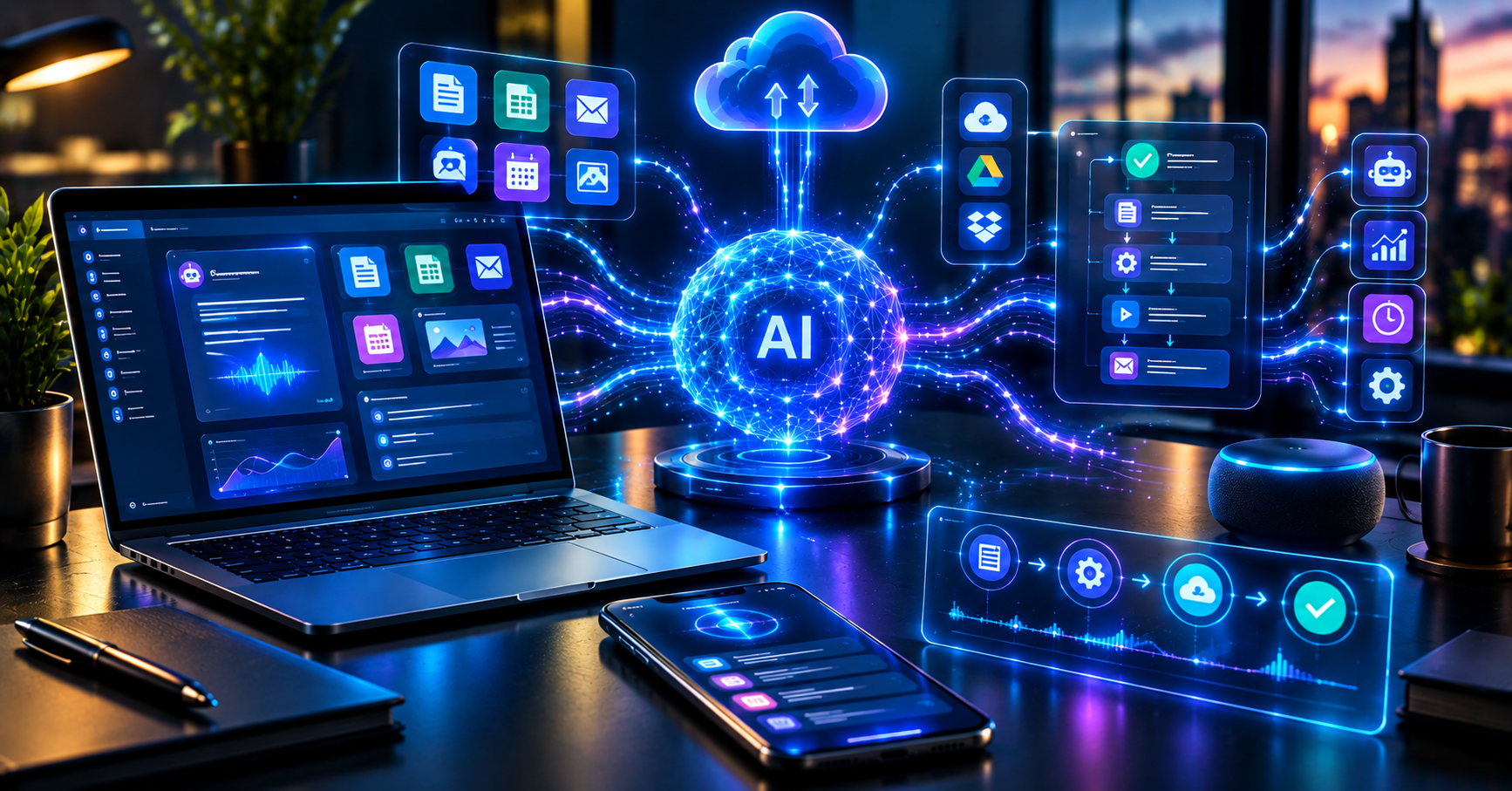
AI agents introduce another possibility: tell the system what you want and allow it to coordinate the necessary tools.
Instead of operating ten different applications separately, users could increasingly interact with an AI system that connects those applications together.
This could make software more accessible, particularly for people who do not want to learn the complicated workflows behind every application.
Are AI Agents Replacing Chatbots?
Not necessarily.
Chatbots and AI agents serve different purposes.
If you need an explanation, brainstorming partner, tutor, or conversational assistant, a chatbot can be extremely useful.
If you need a system to complete a multi-step process using external tools, an AI agent may be more appropriate.
In fact, the two technologies are likely to work together.
A future AI assistant could have a chatbot-like conversational interface while using agent capabilities behind the scenes.
You could simply state your goal in natural language while the underlying agent handles the individual steps.
What Are the Risks of AI Agents?
Greater autonomy also creates greater risks.
An AI system that can take actions has more opportunities to make mistakes than one that only generates text.
An agent could misunderstand an instruction, use incorrect information, expose sensitive data, or perform an unwanted action if its permissions are poorly controlled.
This makes security extremely important.
Organizations using AI agents will need safeguards such as permission controls, human approval for sensitive actions, activity monitoring, data protection, and clear limits on what an agent can access.
The more an AI system can do, the more carefully its actions need to be controlled.
The Future of AI Agents
AI agents represent an important shift in artificial intelligence: From answering questions to accomplishing goals.
Chatbots helped make AI conversational. Agents could make AI more action-oriented.
Instead of asking an AI how to complete a task, people may ask it to complete parts of the task itself.
That does not mean humans become irrelevant.
In many situations, the most effective model will be collaboration. Humans can define objectives, provide judgement, approve important decisions, and handle exceptions, while AI agents take care of repetitive or time-consuming steps.
That chatbot taught computers to talk with us.
AI agents are pushing computers toward working with us.
And that could make AI agents one of the most important developments in the next of software.