

The Cloud Revolution: How Cloud Computing Is Changing the World
What if someone asked you to name the technology you use most everyday?
You might say your smartphone, laptop, or even the Internet. But behind all of these is an invisible technology that quietly powers much of your digital life—cloud computing.
Every photo you back up, every movie you stream, every email you send, every document you edit online, and every video call you join depends on the cloud. It works silently behind the scenes, connecting billions of people to their data, applications, and services in a matter of seconds. Yet, despite using it almost every day, many people have little idea of what it is or why it matters.
Cloud Computing has revolutionized the way we live, work, learn, and do business. It has made technology more accessible, affordable, and powerful than ever before, enabling everyone from students and businesses to multinational corporations to access world-class computing resources with just an internet connection.
So, what exactly is cloud computing? How does this “invisible” technology work, and why has it become the backbone of today’s digital world? In this article, we will break down cloud Computing in simple terms, explore it’s real-world applications, and discover why it is one of the most important innovation of the modern era.
What Is Cloud Computing?
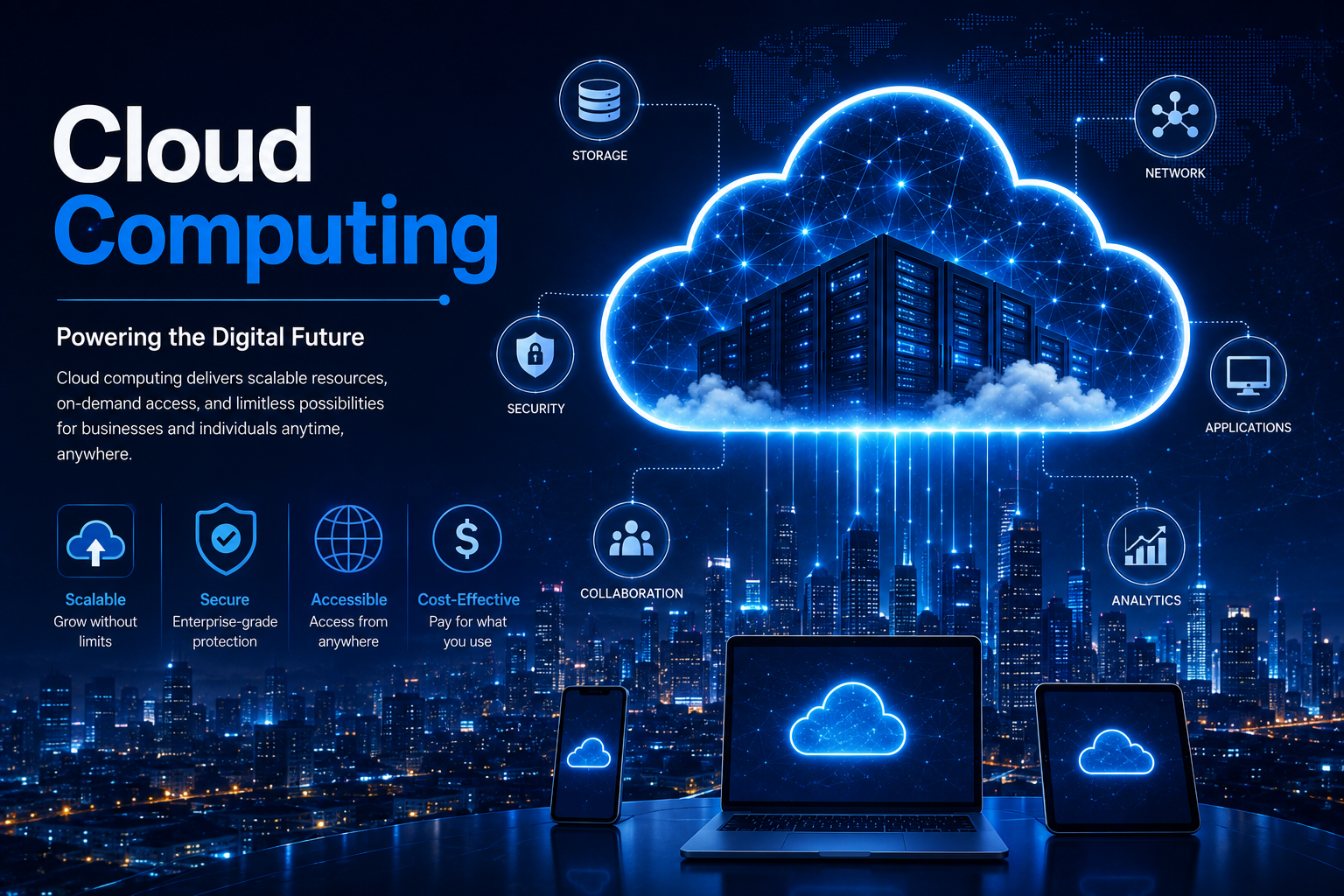
Cloud computing is an Internet-based computing system that provides on-demand access to shared computing resources—including storage, software, databases, networking, processing power, and analytics—over the Internet instead of relying only on a personal computer or local server.
In simple terms, cloud computing means that your files, applications, and data are stored and managed on powerful computers called servers, which are located in secure data centers around the world. Instead of installing everything on your own device, you access these resources through the Internet whenever you need them.
Think of the cloud as a giant warehouse. Rather than keeping all your belongings inside your house, you store them in a secure storage facility that you can visit whenever you want. The warehouse is maintained by professionals, protected with advanced security, and always available. Cloud computing works in much the same way.
A Brief History of Cloud Computing
The concept of cloud computing dates back to the 1960s, when computer scientist John McCarthy suggested that computing resources could someday be delivered like electricity.
In the 1990s, internet speeds improved, making remote computing more practical.
During the 2000s, companies such as Amazon, Google, and Microsoft invested heavily in cloud infrastructure, making cloud services available to businesses and individuals worldwide.
Today, cloud computing powers everything from smartphone and streaming services to artificial intelligence and smart homes.
How Does cloud Computing Works?
Behind every cloud service are thousands of powerful computers working together. These computers, known as servers, are connected through high-speed networks inside massive data centers.
When you upload a file to a cloud service, several things happen:
- Your device sends the file over the internet.
- The cloud provider stores it on secure servers.
- The information is often copied to multiple locations as a backup.
- Whenever you need the file, it is delivered back to your device almost instantly.
The process happens within seconds, making cloud computing feel effortless even though complex technology is operating behind the scenes.
The Types of Cloud Computing
1. Public Cloud
The public cloud is the most common type. Its services are available to anyone over the internet. The provider owns and manages the infrastructure.
Examples include:
- Google Drive
- Microsoft OneDrive
- Dropbox
- Gmail
- Google Photos
Most people interact with public cloud services everyday.
2. Private Cloud
A private cloud is dedicated to a single organization. It offers greater security and control, making it ideal for businesses handling sensitive information.
Banks, hospitals, and governments agencies often use private clouds because they require greater control over delicate information.
3. Hybrid Cloud
Hybrid cloud combines public and private cloud services, allowing organizations to balance flexibility, security, and cost.
For example, a company may store confidential employee records in a private cloud while using a public cloud to host its website.
4. Multi-Cloud
A company uses multiple cloud providers rather than relying on just one.
Main Cloud Service Models
1. Infrastructure as a Service (IaaS)
Provides virtual servers, networking, and storage.
Ideal for developers and IT professionals.
2. Platform as a Service (PaaS)
Provides tools that allow developers to build and deploy applications without managing servers.
3. Software as a Service (SaaS)
Ready-to-use software delivered through the internet.
Examples include Gmail, Zoom, Canva, Dropbox, and Microsoft 365.
Why Does Cloud Computing Matter?
Cloud computing has become one of the most important technologies because it solves many challenges faced by individuals and organizations.
Access Your Data Anywhere
One of the biggest advantages is accessibility.
Whether you are at home, at work, in school, or traveling abroad, your files remain available through the Internet.
You no longer have to carry flash drives or external hard disks everywhere you go.
Better Collaboration
Cloud computing makes teamwork easier than ever.
Several people can work on the same document simultaneously without sending multiple copies through email.
Students can complete group assignments together, while businesses can collaborate with employees located across different cities or countries.
Saves Money
Buying expensive servers, networking equipment, and software licenses can cost thousands of dollars.
Cloud computing allows businesses to rent only the resources they need.
This reduces costs while giving organizations access to enterprise-level technology.
Automatic Backup
Accidents happen.
Phones get stolen.
Computers crash.
Hard drives fail.
Cloud computing automatically backs up important files, making it easier to recover lost information.
Easy to Scale
Imagine launching a small online store that suddenly becomes popular.
Instead of buying more hardware, cloud providers can quickly increase your storage and computing power.
Likewise, if demand decreases, you can reduce resources and avoid paying for unused capacity.
Automatic Updates
Cloud providers regularly improve their services by fixing bugs, adding new features, and strengthening security.
Users benefit from these updates without manually installing software.
Cloud Computing in Everyday Life
Many people think cloud computing is only for technology companies.
In reality, it is everywhere.
Here are a few examples.
Email Services
Gmail, Outlook, and Yahoo Mail store emails online rather than on your computer.
Streaming Platforms
Netflix, YouTube, Disney+, and Spotify delivers entertainment directly from cloud servers.
Instead of downloading entire movies, content is streamed instantly.
Online Storage
Google Drive, Dropbox, OneDrive, and iCloud allow users to store documents, photos, and videos online.
Social Media
Facebook, Instagram, TikTok, X, and LinkedIn rely on cloud infrastructure to serve billions of users worldwide.
Online Learning
Educational platforms such as Google Classroom, Microsoft Teams, and Zoom depend heavily on cloud computing to support virtual classrooms.
Online Shopping
Amazon, Jumia, eBay, and many e-commerce platforms rely on cloud computing to manage products, customer accounts, and secure payments.
How Businesses Benefit from Cloud Computing
Cloud computing has transformed businesses of every size.
Companies can:
- Launch websites quickly
- Build mobile applications
- Store customer information securely
- Analyze large amounts of data
- Improve customer service
- Support employees working remotely
Instead of spending months building expensive computer infrastructure, businesses can begin using cloud services within hours.
Cloud Computing in Different Industries
Education
Schools use cloud technology for online classes, assignment submissions, digital libraries, and collaboration.
Students can learn from anywhere with an Internet connection.
Healthcare
Hospitals use cloud computing to securely manage patient records, schedule appointments, and support telemedicine services.
Banking
Banks rely on cloud technology for mobile banking, fraud detection, secure transactions, and customer account management.
Government
Governments use cloud computing to provide online services, manage public records, and improve communication with citizens.
Entertainment
Streaming services depends on cloud computing to deliver music, movies, television shows, and live sports to millions of viewers simultaneously.
Advantages of Cloud Computing
Cloud computing offers numerous benefits.
Some of the most important include:
- Lower operating costs
- Flexible storage
- Remote accessibility
- Improved collaboration
- Faster software development
- Better disaster recovery
- Automatic updates
- High reliability
- Increased productivity
- Easier business expansion
These benefits explain why organizations around the world continue investing heavily in cloud technology.
Challenges of Cloud Computing
Despite its many advantages, cloud computing also has limitations.
Internet Dependency
Without a stable Internet connection, access to cloud services may become difficult.
Security Concerns
Although cloud providers invest heavily in cybersecurity, users must also protect their accounts by using strong passwords and multi-factor authentication.
Privacy Issues
Organizations handling sensitive information must ensure they comply with privacy regulations and industry standards.
Service Outages
Occasionally, cloud providers experience technical problems that temporarily interrupt access to services.
Although such outages are usually resolved quickly, they can affect businesses that depend entirely on cloud systems.
Vendor Lock-In
Switching from one cloud provider to another may require time, planning, and additional costs.
For this reason, businesses carefully evaluate providers before making long-term decisions.
The Future of Cloud Computing
Cloud computing continues to evolve rapidly.
Emerging technologies such as Artificial Intelligence(AI), Machine Learning, the Internet of Things (IoT), edge computing, and 5G networks are expanding what cloud platforms can do.
In the future, cloud services will become even faster, more intelligent, and more secure.
Businesses will automate more processes, schools will deliver richer digital learning experiences, hospitals will improve patient care through connected systems, and smart cities will depend on cloud infrastructure to manage transportation, utilities, and public services.
As technology becomes increasingly connected, cloud computing will remain the foundation that supports innovation across nearly every industry.
Skills Worth Learning About Cloud Computing
If you are interested in building a career in technology, learning cloud computing can be a valuable investment.
Some beginner-friendly skills include:
- Understanding cloud storage
- Learning networking basics
- Exploring virtual machines
- Studying cybersecurity fundamentals
- Understanding databases
- Learning cloud platforms like Amazon Web Services (AWS), Microsoft Azure, or Google Cloud Platform (GCP)
These skills are in high demand and can open doors to careers in IT support, cloud engineering, software development, cybersecurity, and data analysis.
Final Thoughts
Cloud computing has fundamentally changed the way people and organizations use technology. Instead of relying on expensive hardware and local storage, users can access powerful computing resources through the internet whenever they need them.
From saving family photos and streaming music to supporting hospitals, banks, businesses, and governments, cloud computing has become an invisible but essential part of modern life. It offers convenience, flexibility, scalability, and cost savings while enabling innovation on a global scale.
As our dependence on digital services continues to grow, understanding cloud computing is no longer just for IT professionals. It is becoming an essential part of digital literacy. Whether you are a student, entrepreneur, or technology enthusiast, learning how cloud computing works will help you better understand the digital world and prepare you for the future of technology.