

The Sinister Science of Why You Can not Put Your Phone Down
It is a quiet evening. You are trying to read a book, finish a project, work on an article or simply hold a conversation with your partner. Then, it happens. A soft, high-pitched ping cuts through the silence, accompanied by a sharp, rhythmic vibration on the coffee table.
You don’t just hear it; you feel it.
In today’s digital world, notifications have become a constant part of our daily lives. From text messages and emails to social media alerts and app updates, our phones are always competing for our attention. What makes these simple sounds and pop-up alerts so difficult to ignore? Why do we feel compelled to check our devices almost instantly, even when we know the notification may not be important?
The answer lies in psychology. Technology companies have learned how to design notifications that tap into our natural curiosity, desire for social connection, and need for rewards. By understanding the science behind these digital interruptions, we can better understand our own behavior and learn how to use technology more intentionally.
In this article, we will explore why notifications are so hard to ignore, how the buzz, beep, and click shape our behavior and what this means for our focus and productivity.
The Human Brain and the Need for Information
Humans are naturally curious. Our brains are wired to seek information because, throughout history, information often meant survival. Knowing about potential dangers, opportunities or social developments helped our ancestors make better decisions.
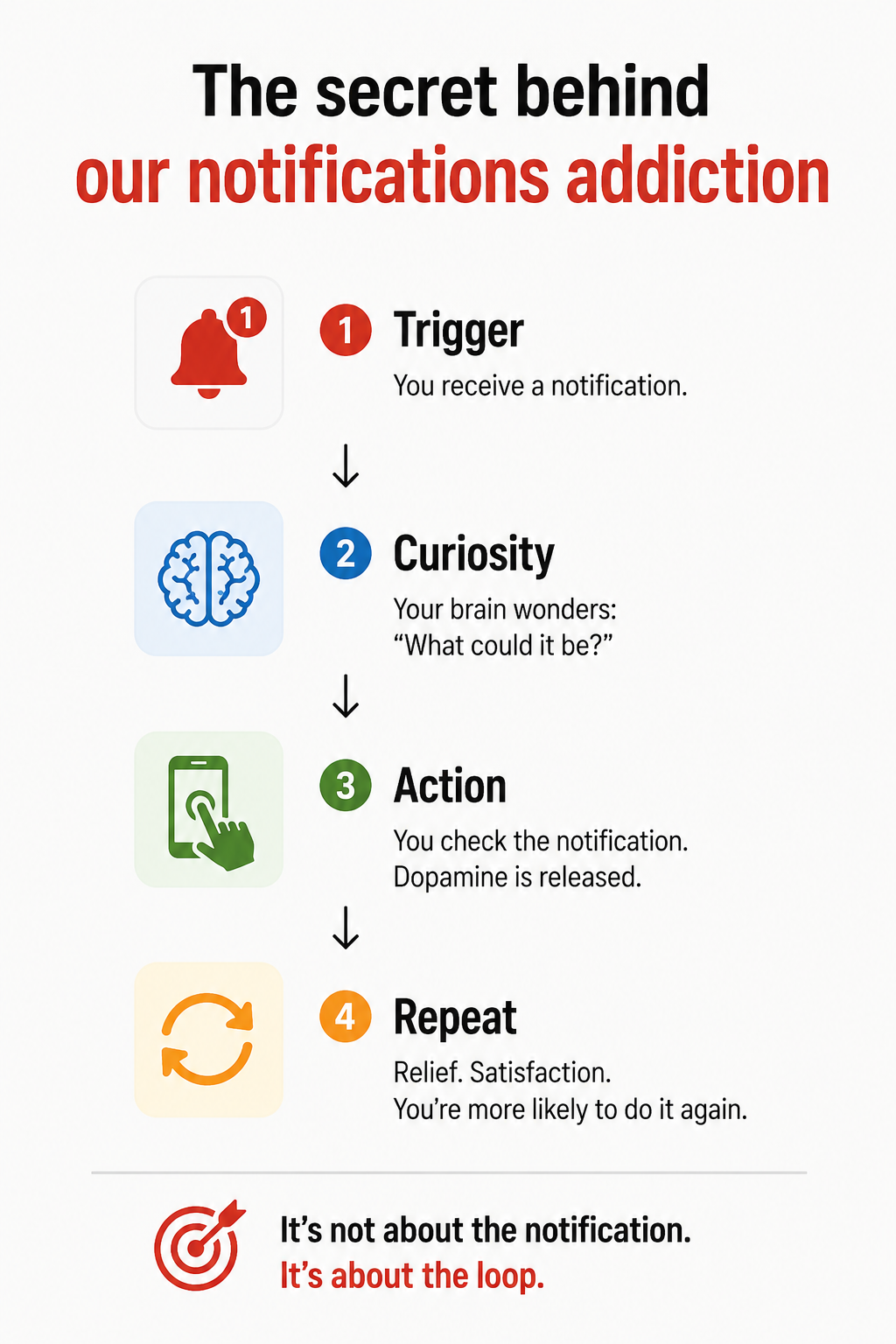
Today, notifications exploit this same instinct. Every buzz it alert creates a sense of uncertainty. We wonder who sent the message, what the update is, or whether something important requires our attention. The curiosity creates a mental urge to check our phones immediately.
The Role of Dopamine
Many people believe dopamine is the “pleasure chemical,” but it is more accurately associated with motivation and anticipation.
When a notification arrives, the brain anticipate a potential reward:
- A message from a friend
- A social media like or comment
- Good news from work
- An exciting update
Thus anticipation triggers dopamine activity, encouraging us to check our devices. Even if the notification turns out to be unimportant, the brain remembers the possibility of reward and continues responding to future alerts.
Variable Rewards: The Slot Machine Effect
One of the most powerful psychological principles behind notifications is the concept of variable rewards.
A slot machine doesn’t pay out everytime. Instead, rewards appear unpredictably, which keeps people playing. Notifications work similarly.
Sometimes a notification is exciting:
- A job opportunity
- A message from someone special
- Breaking news
- Credit alert
Other times it’s insignificant:
- A promotional email
- A random app update
Because we never know which type we are going to receive, we keep checking. The uncertainty itself becomes addictive.
Fear of Missing Out (FOMO)
Another reason notifications are difficult to ignore is the Fear of Missing Out, commonly known as FOMO.
Social media platforms constantly update with:
- New posts
- Trending topics
- Messages
- Videos
People often worry that if they don’t check immediately, they might miss something important or interesting. This fear creates anxiety and encourages frequent phone checking throughout the day.
For younger generations who have grown up with digital technology, FOMO can be especially powerful because social interaction increasingly takes place online.
Social Validation and Human Connection
Humans are social creatures. Throughout history, belonging to a group increased chances of survival.
Today, notifications often represent social interaction:
- Likes
- Comments
- Shares
- Direct messages
Each alert can feel like confirmation that we are noticed, valued, or connected to others. This social validation creates positive emotional responses and reinforces the habit of checking our phones frequently.
The stronger the emotional connection to platform or group, the harder it becomes to ignore notifications from it.
How Tech Companies Design Notifications
Notifications are not always accidental features. Many technology companies invest significant resources into understanding user behavior.
Design teams carefully consider:
- Notification timing
- Sound effects
- Visual cues
- Badge counts
- Personalized messages
These elements are designed to maximize engagement and encourage users to return to apps more often.
For businesses, user attention translates into increased activity, stronger customer retention, and often greater revenue.
The Impact on Attention and Productivity
While notifications can be useful, excessive alerts can negatively affect concentration.
Research has shown that interruptions can:
- Break focus
- Increase stress
- Reduce productivity
- Extend the time needed to complete tasks
Even when we choose not to check a notification immediately, simply hearing or seeing it can occupy mental resources. Part of our attention remains focused on the unanswered alert.
Over time, constant interruptions can contribute to mental fatigue and decreased efficiency.
The Effect on Mental Health
Heavy notification use has also been linked to various mental health challenges.
Constant connectivity can create:
- Anxiety
- Information overload
- Stress
- Sleep disruption
Many people feel pressure to respond immediately to messages and updates. This expectation can make it difficult to disconnect and fully relax.
Nighttime notifications are particularly problematic because they can interrupt sleep patterns and reduce sleep quality.
Taking Back Control
The goal is not to eliminate technology entirely. Notifications can be valuable for communication, emergencies, and important reminders.
However, users can regain control by:
- Turning off non-essential notifications
- Using “Do Not Disturb” mode
- Setting specific times to check apps
- Removing unnecessary apps
- Keeping phones out of reach during focused work
Small changes can significantly reduce distractions and improve concentration.
Conclusion
Notifications may seem like simple digital alerts, but their influence goes far beyond a sound, vibration, or pop-up message. They are careful designed to capture out attention by appealing to some of the most fundamental aspects of human psychology, including curiosity, anticipation, social connection, and the desire for rewards.
As smartphones become increasingly integrated into our daily lives, understanding the science behind notifications is more important than ever. While these alert help us stay informed and connected, they can also distract us, reduce productivity, and make it harder to focus on what truly matters.
The next time your phone buzzes, beeps , or lights up, take a moment before reaching for it. You may discover that the notification is not controlling your behavior but your choices are.