How Blockchain and Cryptocurrency are Transforming Finance.
What if money could move across the world in seconds without the help for banks, financial institutions, or governments? This idea, once considered impossible, is becoming a reality through Blockchain technology and cryptocurrencies. Over the past decade, these innovations have challenged traditional financial systems and sparked global discussions about the future of money.
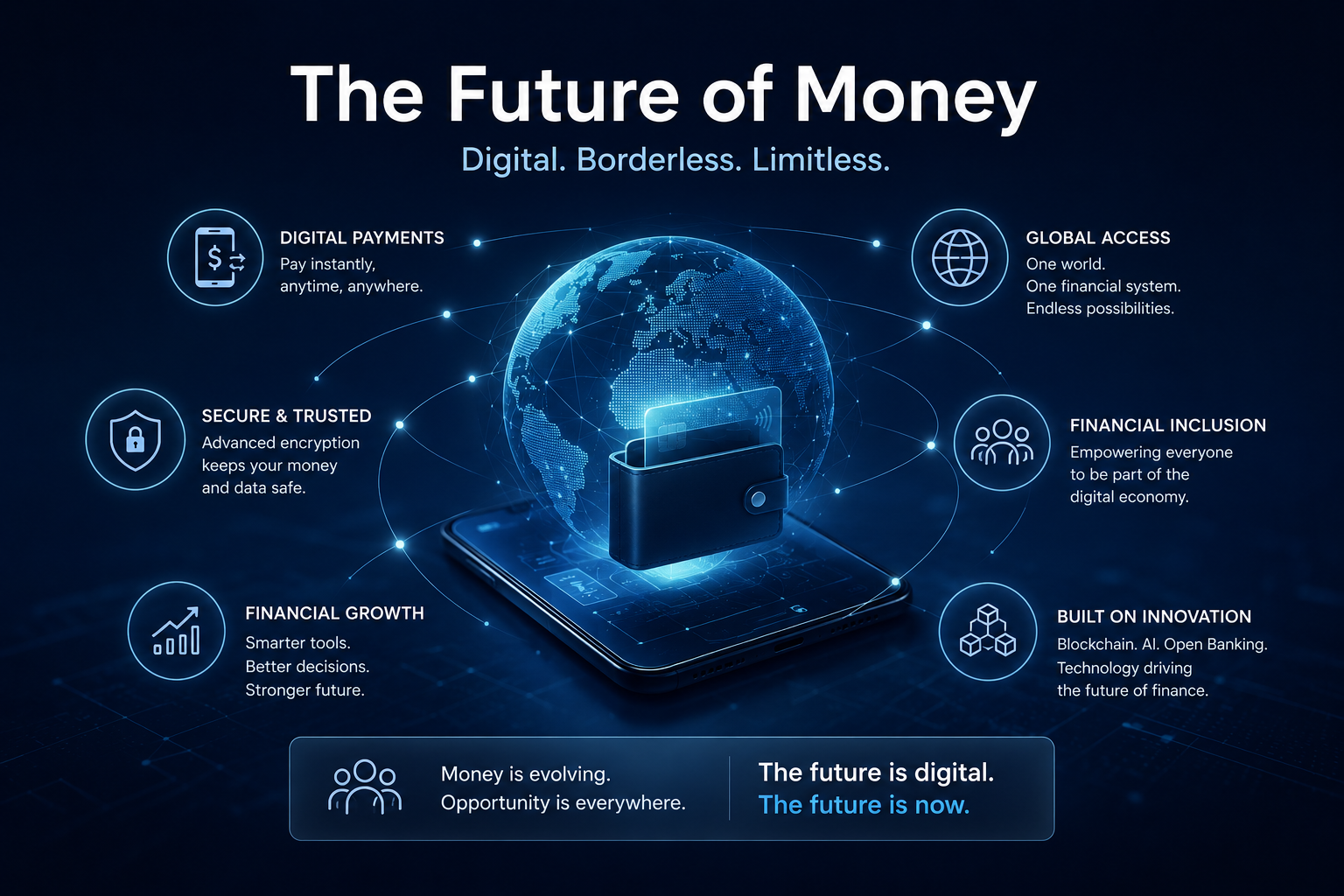
The future of money is no longer about just about cash, cards or mobile banking. It is about decentralization, transparency, and digital ownership. As adoption continues to grow, understanding how Blockchain and Cryptocurrency work has become increasingly important for individuals, businesses, and governments alike.
This article explores the future of money, how Blockchain and Cryptocurrency are driving this change, and what it means for individuals, businesses and the global economy.
Understanding Money in the Digital Age
Money has always evolved with human civilization. From bartering goods using coins, paper nots, and now digital payments, each stage reflects a shift in how people exchange value.
Today, most money already exists in digital form. When you transfer funds through mobile banking or pay with a card, you are not physically moving money—you are updating records in a financial database controlled by banks.
Nonetheless, this system still relies heavily on intermediaries. Banks, payment processors, and governments act as central authorities. While this structures has worked for decades, it also comes with limitations such as delays, fees, restrictions, and lack of full transparency.
This is where Blockchain enters the conversation.
What is Blockchain?
Blockchain is a digital record-keeping system that stores information in a way that is secure, transparent and difficult to alter.instead of keeping data in a single location controlled by one organization, blockchain distributes copies of the same record across a network of computers. This decentralized structure makes the system more reliable and resistant to tempering.
The term “Blockchain” comes from the way information is organized. Data is grouped into blocks, and each block is linked to the previous one, forming a chain. Every block contains information such as transaction details, a timestamp, and a unique code that connects it to the block before it. Once a block is added to the chain, changing its contents becomes extremely difficult because doing so would require altering every subsequent block and gaining approval from the majority of the network.
To understand Blockchain more clearly, imagine a shared digital notebook that thousands of people can view. Whenever a new entry is added, everyone receives an updated copy. No one can secretly erase or change previous entries because the entire network would immediately detect the discrepancy.
As organization continue to seek more secure and efficient ways to store information, Blockchain is emerging as one of the most transformative technologies of the digital age.
What is Cryptocurrency?
Cryptocurrency is a form of digital or virtual currency that uses cryptographic technology to secure transactions and control the creation of new units. Unlike traditional currencies issued by governments and central banks, cryptocurrencies operate on decentralized networks, typically powered by blockchain technology.
The first and most well-known cryptocurrency is Bitcoin, which was introduced in 2009. Bitcoin was created as an alternative to traditional financial systems, allowing people to send and receive money directly without relying on banks or payment processors.
Bitcoin remains the largest cryptocurrency by market value and is often referred to as “digital gold” because many investors view it as a store of value. Ethereum, another major cryptocurrency, goes beyond simple payments by enabling smart contracts—self-executing agreements that automatically perform actions when specific conditions are met
They are designed to allow peer-to-peer transactions, meaning users can send and receive money directly without intermediaries.
Cryptocurrencies can be used for payments, investments, and even powering applications built on blockchain networks.some are designed to store value, while others are used to run smart contracts.
What makes cryptocurrency unique is that it is built on cryptographic security, making it difficult to counterfeit or manipulate.
How Blockchain and Cryptocurrency Work Together.
Blockchain is the foundation, and cryptocurrency is one of its most popular applications.
When a Cryptocurrency transaction occurs. It is broadcast to a network of computers. These computers verify the transaction using complex algorithms. Once verified, the transaction is added to a block, and that block is added to the chain.
This process ensures transparency, security, and accuracy without the need for a central authority.
In simple terms:
- Blockchain is the system
- Cryptocurrency is the money that runs on it
Together, they create a financial ecosystem that operates independently of traditional banking systems.
The Benefits of the Future Financial System
The rise of Blockchain and cryptocurrency introduces several potential benefits that will reshape global finance
1. Faster Transactions
Traditional international transfers can take days. Blockchain transactions will happen in minutes or even seconds.
2. Lower Costs
By removing intermediaries, transaction fees can be significantly reduced.
3. Financial Inclusion
Millions of people around the world do not have access to traditional banking. Blockchain-based systems can provide financial services to anyone with Internet access.
4. Transparency
Every transaction is recorded on a public ledger, making systems more transparent and accountable.
5. Security
Because of encryption and decentralization, blockchain systems are highly resistant to fraud and hacking.
Challenges Facing the Future of Money
Despite its potential, the future of money is not without challenges.
1. Volatility
Cryptocurrency prices can change rapidly, making them unstable as a store of value.
2. Regulation
Governments around the world are still figuring out how to regulate digital currencies.
3. Security Risks
While Blockchain itself is secure, exchange and wallets can still be vulnerable to attacks.
4. Adoption Barriers
Many people still do not understand how blockchain works, which slows down adoption.
5. Environmental Concerns
Some blockchain systems consume large amounts of energy, raising sustainable concerns.
Real-World Applications Beyond Currency
Blockchain is not limited to financial transactions. Its applications are expanding into many industries.
Supply Chain Management
Companies can track products from production to delivery with full transparency.
Healthcare
Patient records can be securely stored and shared across medical institutions.
Voting Systems
Blockchain could make elections more transparent and reduce fraud.
Digital Identity
Individuals could control their own identity data without relying on centralized databases.
Entertainment and Digital Ownership
Artists and creators can sell digital assets directly to consumers without intermediaries.
The Role of Governments and Banks
Rather than disappearing, banks and governments are likely to adapt.
Many central banks are already exploring digital currencies issued by governments, known as Central Bank Digital Currencies (CBDCs). These combine traditional monetary control with digital efficiency.
Banks may evolve into service providers for blockchain-based systems, offering custody, regulation compliance, and integration services.
The financial system of the future may not be fully decentralized or fully traditional —but a hybrid of both.
The Future Outlook
The future of money is still being written. However, several trends are becoming clear:
- Digital payment will continue to dominate
- Blockchain adoption will expand across industries
- Cryptocurrency will evolve beyond speculation into practical use
- Financial systems will become me interconnected and digital.
We are moving toward a world where money is no longer just physical but programmable, borderless, and transparent.
Conclusion
The future of money is not a distant concept—it is already unfolding. Blockchain and cryptocurrency are challenging long-standing financial systems and introducing new ways of thinking about value, trust, and ownership.
As the digital economy continues to expand, understanding blockchain and cryptocurrency is becoming increasingly important. Whether these technologies completely reshape global finance or simply become part of existing systems, their influence is likely to grow in the years ahead. For individuals, businesses and policymakers alike, staying informed about these innovations will be essential for navigating the future of finance and technology.