
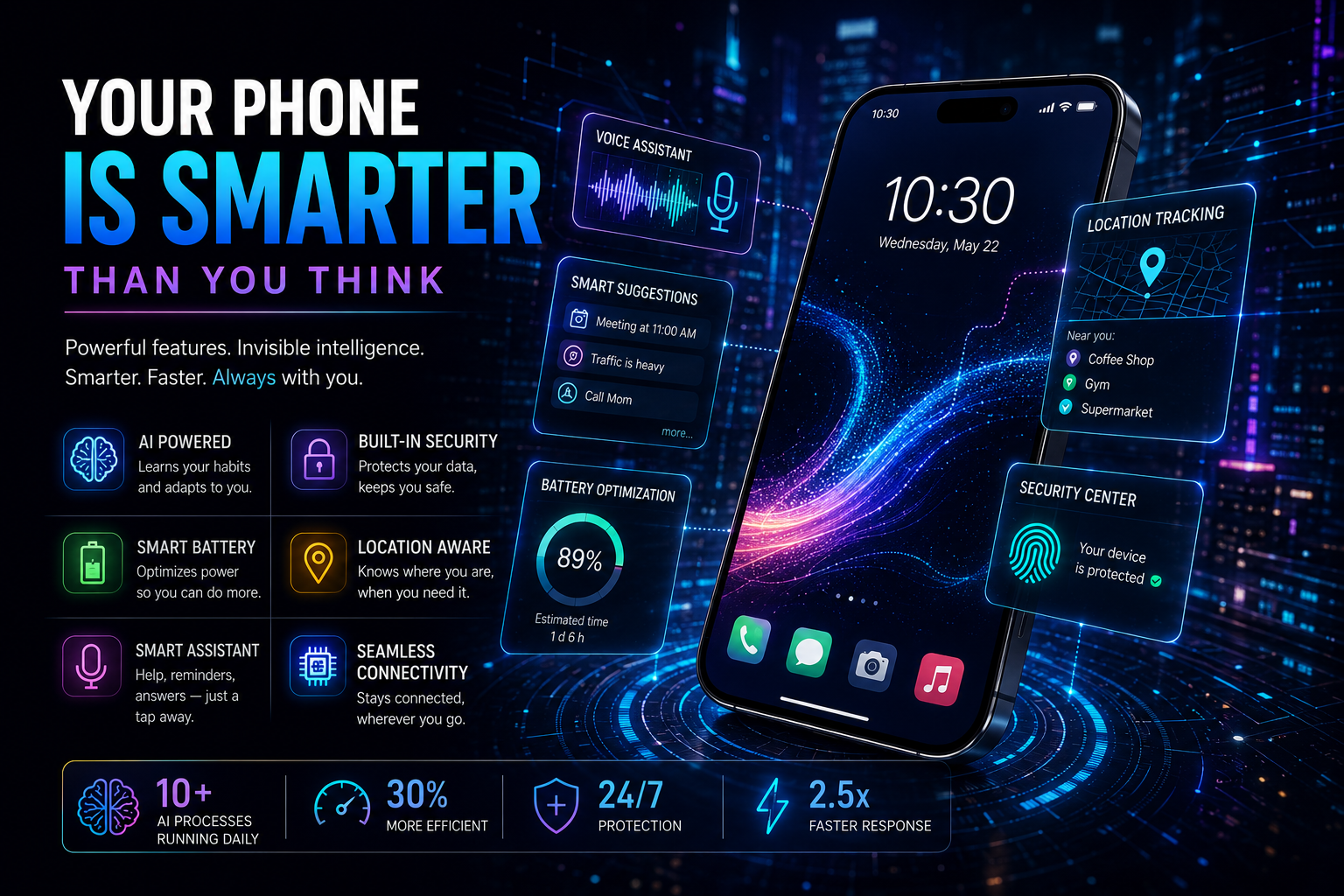
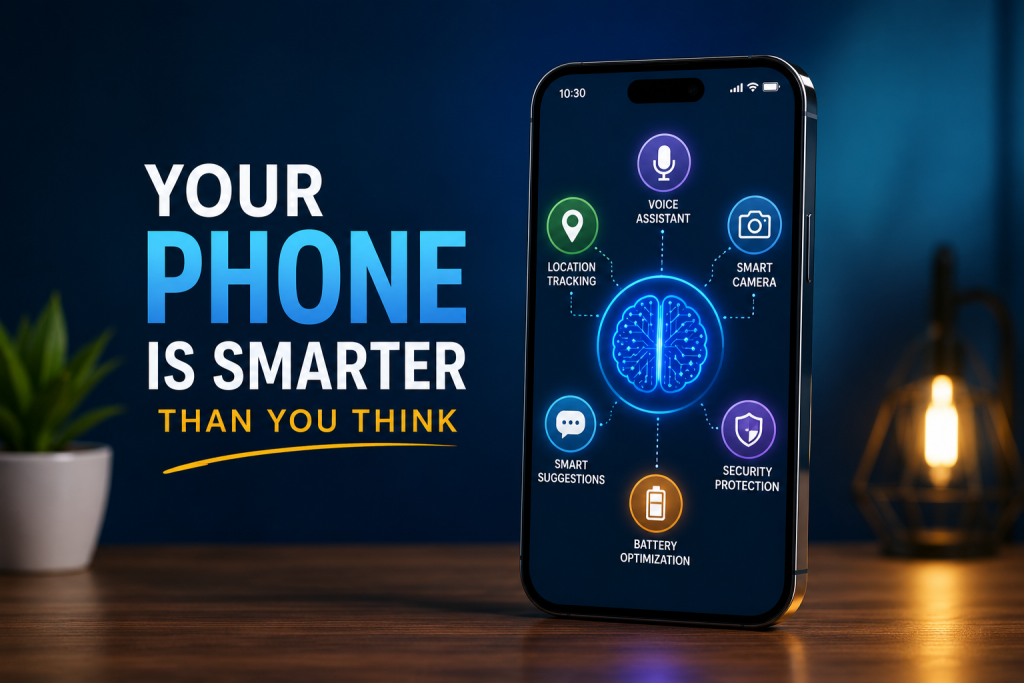
 Hidden Tech You Use Everyday
Take a moment and look at your smartphone. It probably sits in your pocket, on your desk, or in your hand for hours every day. You use it to send messages, browse social media, take pictures, watch videos, and maybe even work or study. To most people, a smartphone is simply a communication device or an entertainment gadget.
But what if I tell you that your phone is far smarter than it appears?
Everytime you unlock your screen with your face, ask for directions, connect to Wi-Fi, take a picture, or receive a weather update, dozens of advanced technologies are quietly working behind the scenes. These features have become so common that we rarely stop to think the incredible engineering that makes them possible.
Modern smartphones are like tiny supercomputers. They contain powerful processors, multiple sensors, artificial intelligence systems, and sophisticated software that work together seamlessly. In fact, the smartphone in your pocket today is more powerful than many computers from just a few decades ago.
The fascinating part is that much of your phone’s intelligence is hidden. You use, these technologies every day without even noticing them. Understanding how they work not only helps you appreciate your device more but also gives you a glimpse into how modern technology is shaping our lives.
Let’s explore some of the hidden technologies that make your smartphone smarter than you think.
1. Artificial Intelligence Learns your Habits
One of the most impressive technologies inside your smartphone is Artificial Intelligence (AI).
AI enables your phone to learn from your behavior and make intelligent decisions. It studies how you use your device and gradually adapts to your habits.
Have you noticed that your keyboard often predicts the next word you are about to type? That is the work of AI. Does your phone suggest a playlist you might enjoy or recommend apps based on your routine? That is AI again.
Virtual assistants such as Google Assistant and Siri also rely heavily on AI. They can answer questions, set reminders, play music, and even understand natural speech patterns.
AI also helps your phone:
- Organize photos automatically
- Improve battery efficiency
- Filter spam calls and messages
- Translate languages in real time
- Recommend content based on your interests
The more you use smartphone, the more it learns about your preferences, making your experience increasingly personalized.
2. GPS Knows Exactly Where You Are
Have you ever wondered how your phone can accurately guide you to a restaurant, show nearby stores, or estimate your arrival time?
The answer lies in Global Positioning System (GPS) technology.
GPS works through a network of satellites revolving the Earth. Your phone communicates with several of these satellites simultaneously to determine your precise location.
However, modern smartphones use more than just Satellites.
They combine GPS data with:
- Wi-Fi signals
- Cellular towers
- Bluetooth technology
- Motion sensors
By combining information from multiple sources, your phone can locate you with remarkable accuracy.
GPS powers many everyday services, including:
- Navigation apps
- Ride-hailing services
- Food delivery tracking
- Weather applications
- Fitness trackers
- Location sharing
Without GPS, many of the conveniences we now take for granted would be impossible.
3. Face Recognition Uses Advanced Mathematics
Unlocking your phone with your face may feel like magic, but it depends on highly refined technology.
Face Recognition systems map your facial features by analyzing unique characteristics such as:
- The distance between your eyes
- The shape of your nose
- The contours of your face
- The position of your mouth and jawline
Many smartphones create detailed mathematical models of your face rather than storing simple pictures.
Advanced face recognition systems also use infrared sensors and depth detection to ensure precision even in low light conditions.
This technology allows your device to:
- Unlock securely
- Authorize payments
- Protect sensitive information
- Verify your identity quickly
What once seemed like science fiction is now a feature millions of people use every day.
4. Your Camera Is Powered by Computational photography
Smartphone camera have improved dramatically over the years. Yet much of the improvement comes not from better lenses but from smarter software.
This technology is called Computational photography.
When you take a photo, your phone often captures multiple images in fractions of a second. AI then analyzes and combines these images to create a better final picture.
Computational photography enables features like:
- Portrait mode
- Night mode
- Automatic scene optimization
- HDR imaging
- Image stabilization
For example, night mode works by taking several photos with different exposure levels and combining them to produce a brighter and clearer image.
In many ways, your phone behaves like a miniature photography studio that processes images instantly.
5. Sensors Constantly Monitor the World Around You
Smartphones contain numerous sensors that helps them understand their environment.
Accelerometer
This sensor detects movement and orientation.
It allows your screen to rotate instantly and tracks physical activities like walking and running.
Gyroscope
The gyroscope measures rotation and movement.
It helps power:
- Mobile gaming
- Navigation systems
- Augmented reality applications
Proximity Sensor
This sensor detects nearby objects.
For example, it turns off your display when you hold your phone against your ear during calls.
Ambient Light Sensor
This technology measures surrounding light levels and adjusts your screen brightness automatically.
These sensors work continuously, often without users realizing they exist.
6. Your Phone Predicts What You Want
Many smartphone features seem to anticipate your needs.
Your device may:
- Suggest leaving early because of traffic
- Recommend apps at certain times
- Predict destinations
- Suggest responses to messages
- Display frequently used contacts
This predictive behavior count on machine learning.
Your phone analyzes patterns and historical data to make intelligent recommendations.
For instance, if you regularly open a music app every morning, your device may seamlessly suggest it around the same time each day.
These small conveniences create a smoother and more personalized experience.
7. Cloud Technology Extends Your Phone’s Capabilities
Your smartphone would be far less useful without cloud technology.
The cloud refers to remote servers that store and process information over the Internet.
Cloud services allow you to:
- Back up photos
- Sync contacts
- Save documents
- Access files from multiple devices
- Recover data if your phone is lost
Streaming services alse lean on cloud technology.
Instead of storing thousands of songs or videos directly on your phone, cloud servers deliver content whenever you need it.
The cloud essentially gives your smartphone access to vast amounts of storage and computing power beyond its physical hardware.
8. Wireless Communication Happens in Seconds
Your smartphone communicates constantly.
It exchanges information through several wireless technologies.
Wi-Fi
Wi-Fi connects your phone to the Internet without cables.
Bluetooth
Bluetooth enables short-range communication between devices.
It powers:
- Wireless earphones
- Smart watches
- Speakers
- Fitness trackers
Near Field Communication (NFC)
NFC allows devices to exchange information over very short distances.
This technology makes contactless payments possible.
Each of these systems uses radio waves and high-tech communication protocols that operate almost instantly.
9. Security Systems Protect Your Information
Your smartphone contains a surprising amount of personal information.
It stores:
- Passwords
- Financial information
- Emails
- Photos
- Documents
- Private conversations
Protecting this information requires advanced security technologies.
Modern smartphones use:
Encryption
Encryption converts information into unreadable code.
Even if someone steals your phone, encrypted data remains difficult to access.
Biometric Authentication
Fingerprints and facial recognition provide additional layers of security.
Security Updates
Manufacturers regularly release updates that fix vulnerability and improve protection.
These systems work together to keep your digital life safe.
10. Artificial Intelligence Saves Battery Life
Battery Life is one of the biggest concerns for smartphone users.
Fortunately, AI helps optimize power consumption.
Your device studies your usage habits and determines:
- Which apps you use frequently
- Which apps remain inactive
- When you typically charge your phone
Based on these patterns, your phone can:
- Limit background activity
- Reduce unnecessary power usage
- Prioritize important applications
This intelligent management helps extend battery life throughout the day.
11. Augmented Reality Blends Digital and Physical Worlds
Augmented Reality (AR) is another hidden technology that makes smartphones incredibly smart.
AR places digital information on top of the real world.
Examples include:
- Virtual furniture placement
- Interactive games
- Educational applications
- Navigation directions
- Beauty filters
AR combines information from:
- Cameras
- Motion sensors
- AI systems
- GPS
Your phone constantly analyzes its surroundings to position digital objects accurately.
This technology continues to open exciting possibilities for education, shopping, healthcare, and entertainment.
12. Voice Recognition Understands Human Speech
Talking to your phone has become increasingly normal.
Voice recognition technology converts spoken language into digital commands.
This process involves several steps:
- Recording sound waves
- Converting sound into data
- Analyzing speech patterns
- Identifying words and meanings
- Executing commands
Modern voice recognition systems can understand different accents and natural speech patterns with impressive reliability.
They can:
- Send messages
- Set alarms
- Make calls
- Search the Internet
- Answer questions
Voice technology continues to improve and may eventually become one of the primary ways people interact with their devices.
The Future of Smartphone Intelligence
Smartphones are becoming smarter every year.
Future devices may feature:
- More advanced AI assistants
- Improved health monitoring
- Better language translation
- Smarter energy management
- Enhanced augmented reality experiences
- Stronger security systems.
As technologies like AI and machine learning continue to evolve, smartphones will become even better at understanding their users and anticipating their needs.
The line between phones and intelligent digital companions is gradually becoming blurred.
Conclusion
Your smartphone is far more than a device for making calls and scrolling through social media, it is an innovative piece of technology packed with hidden intelligence.
Every day, your phone uses artificial intelligence, GPS, advanced cameras, sensors, wireless Communication systems, cloud computing, security technologies, and predictive algorithms to make your life easier.
Most of these technologies operate quietly in the background, which is why we often overlook them. Yet they power nearly every digital experience we enjoy.
The next time your phone automatically adjusts its brightness, suggests the perfect route home, recognizes your face, or captures an incredible photo, remember this: you are holding one of the most advanced pieces of technology ever created.
Your phone is smarter than you think—and its hidden technologies are working for you every single day.