
 How QR Code Works: The Smart Technology Behind Every Simple Scan
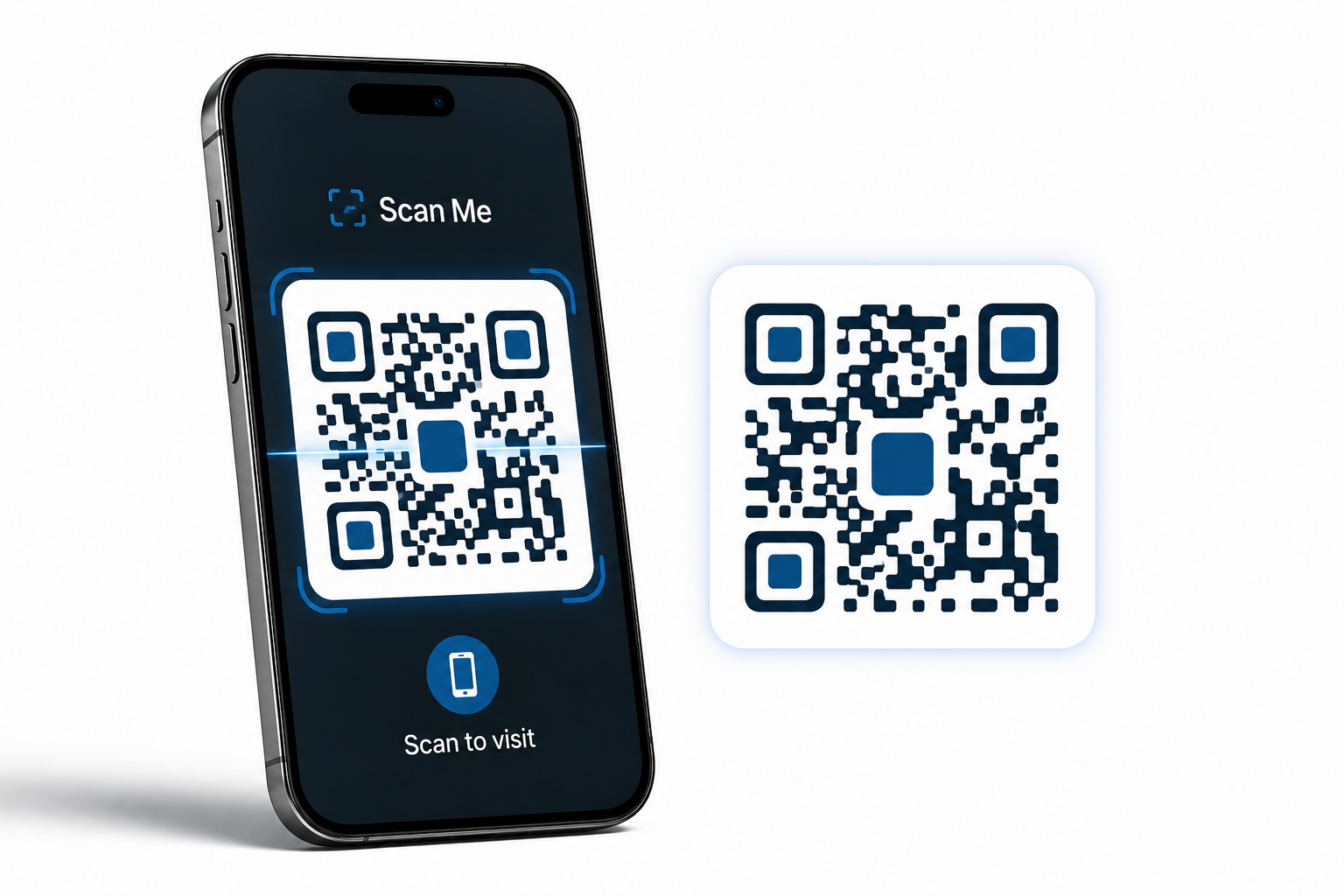
Imagine walking into a restaurant, scanning a small black squares and white spaces, and instantly viewing the menu on your phone. Or paying for groceries, joining a Wi-Fi network, or downloading an app—all with a single scan.
These little pixelated squares, known as QR (Quick Response) codes, have become part of everyday life. They appear on product packaging, business cards, events tickets, advertisements, payment terminals and even museum exhibits. Most of us use them regularly, but few people stop to wonder what actually happens between the moment we point our phone’s camera at a QR code and the moment the information appears on our screen.
How can a collection of tiny black and white squares store so much information? Why do damaged QR codes often still work? And what makes them different from traditional barcodes?
In this guide, we will explore how QR codes work, what information they can store, why they are so reliable, and how they are shaping the future of digital communication.
What is a QR Code?
A QR (Quick Response) code is a two-dimensional barcode that stores information in a grid tiny black and white squares.
Unlike traditional barcodes, which store data in a single horizontal line, QR codes store information both horizontally and vertically. This allows them to hold far more data.
A QR code can contain:
- Website URLs
- Contact information
- Wi-Fi passwords
- Payment details
- Product information
- Event tickets
- GPS Locations
- App download links
- Plain text
Because smartphones now include built-in scanners, using them has become quick and flawless.
History of QR Codes
QR codes were invented in 1994 by Masahiro Hara who works with a Japanese company called Denso Wave, a subsidiary of Toyota.
The company originally designed them to help track vehicle parts during manufacturing. Engineers needed something that could store more information than traditional barcodes while being scanned much faster.
The invention exceeded expectations, and today QR codes are used worldwide in retail, healthcare, education, transportation, banking, lifestyle, and marketing.
Types of QR Codes
- Static QR codes
- Dynamic QR Codes
Static QR Codes
- Cannot be edited after creation.
- Best for permanent information.
Dynamic QR Codes
- Can be updated without changing the QR code.
- Allow scan tracking and Analytics.
- Popular for marketing campaigns.
Why Are They Called “Quick Response” codes?
The name comes from their greatest benefit “speed“.
Instead of manually typing a website address or entering long strings of numbers, users simply point their phone camera at the code.
Within seconds, the information is decoded and displayed.
Understanding the Structure of a QR Code
At first glance, a QR code looks like a random arrangement of tiny squares.
In reality, every section has a specific purpose.
Its main components include:
Finder Patterns
The three large squares located in the corners help your phone instantly recognize the QR code and determine its orientation.
Alignment Patterns
These smaller squares ensure the code can still be read accurately even if it’s slightly tilted or printed on a curved surface.
Timing Patterns
These alternating black and white lines help the scanner determine the size and position of each tiny square.
Data Area
This is where the actual information is stored.
Every tiny square represents binary number, allowing the QR code to encode different types of information.
Quiet Zone
The empty white border surrounding the QR code helps scanners differentiate it from the background.
Without this border, scanning becomes much more difficult.
How Information Is Stored
Computers communicate using binary digits—0s and 1s.
Each tiny square inside a QR code represents part of this binary information.
Special encoding algorithms convert text, numbers,or website links into binary before arranging them into the familiar square pattern.
When your phone scans the code, it performs the reverse process, converting the pattern back into readable information.
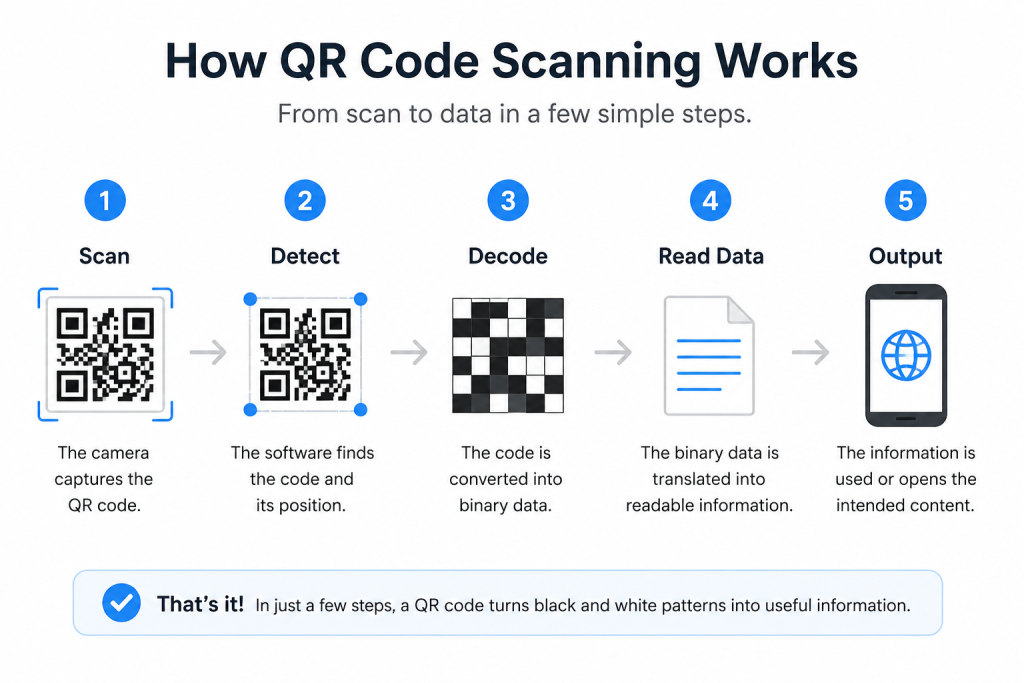
What Happens When You Scan a QR Code?
Scanning a QR code happens surprisingly quickly:
- Your phone’s camera detects the QR code.
- It identifies the three large corner squares.
- The scanner determines the code’s orientation.
- The binary data is extracted.
- Error correction repairs any missing data if necessary.
- The information is decoded.
- Your phone opens the stored content, such as website or contact card.
This entire process usually takes less than a second.
Why Can Damaged QR Codes Still Work?
One of the most exceptional features of QR codes is error correction.
They use mathematical techniques that allow missing or damaged portions of the code to be reconstructed.
This means a QR code can often remain readable even if:
- It is scratched
- Partially torn
- Slightly dirty
- Printed imperfectly
That is one reason QR codes are far more reliable than traditional barcodes.
Common Uses of QR Codes
Today, QR codes are everywhere.
Some of their most common uses include:
- Mobile payments
- Restaurant menus
- Digital tickets
- Business cards
- Product authentication
- Marketing campaigns
- App downloads
- Wi-Fi sharing
- Online forms
- Customer feedback surveys
Their convenience makes them valuable for both businesses and customers.
Are QR Codes Safe?
QR codes themselves are not dangerous.
However, scammers can create malicious QR codes that lead to fake websites or fraudulent payment pages.
To stay safe:
- Only scan codes from trusted sources.
- Check the web address before opening it.
- Avoid scanning damaged stickers placed over real QR codes.
- Keep your phone’s security software updated.
- Never enter personal or financial information on suspicious websites.
A little caution goes a long way.
The Future of QR Codes
As Smartphones become more advanced, QR codes are likely to become even more common.
We can expect increased use in:
- Smart homes
- Digital identity verification
- Contactless healthcare
- Transportation systems
- Retail checkout
- Interactive education
- Augmented Reality experiences
Their simplicity, low cost, and ease of use ensure they will remain an important part of everyday technology.
Final Thoughts
QR codes may look like simple black and white squares, but they are powered by clever engineering that allows them to store and share information almost instantly. From making payments and accessing websites to sharing contact details and connecting to Wi-Fi, they have transformed countless everyday tasks into a quick scan.
Understanding how QR codes work not only satisfies curiosity but also helps you use them more confidently and safely. As technology continues to advance, these versatile codes are likely to become even more integrated into our daily lives, making interactions with the digital world faster, easier, and more convenient.