
 The Technology Behind Every Feed: Why You See What You See
Have you ever opened your social media app and wondered why certain posts appear at the top while others seem to disappear? Maybe you liked a few travel videos yesterday, and suddenly your feed is filled with vacation ideas. Or perhaps you watched a cooking tutorial, and now every other post seems to be about meal guides..
It might feel like the app can read your mind, but what is really happening is much more fascinating.
Behind every scroll, swipe, and recommendation is a strong piece of technology known as social media algorithm. These algorithms decides what you see, when you see it, and even what content you are most likely to interact with. They process enormous amounts of data in real time, learning from your behavior to create a individualized experience that keeps you engaged.
Whether you are a casual user, a content creator, a business owner, or simply curious about how technology works, understanding social media algorithms helps you make better decisions online.
In this article, we will explore what social media algorithms are, how they work behind the scenes, why they sometimes seem to “know” what you are thinking, and how you can use them to your advantage.
What Is a Social Media Algorithm?
A social media algorithm is a set of computer rules and machine learning models that determines which content appears in your feed.
Years ago, social media platforms displayed posts in chronological order, meaning the newest content appeared first. While this was simple, it was not always helpful. Users often missed posts they cared about, especially as platform grew and millions of new posts were published every minute.
Today, instead of showing everything in the order it was posted, platforms rank content based on what they believe you will find more interesting.
Think of the algorithm as a highly intelligent personal assistant. It looks at thousands of possible posts and selects the ones you are most likely to enjoy or engage with.
Why Do Social Media Platforms use Algorithms?
Imagine following 1,000 people. If each person posted just once a day, you will have 1,000 posts to scroll through daily.
Now imagine millions of creators posting videos, photos, stories, and articles every hour.
Showing everything is simply hopeless.
Algorithms helps by filtering content so users spend less time searching and more time seeing what matters most to them.
For social media companies, this also means users stay on the platform longer, interact more and return more often.
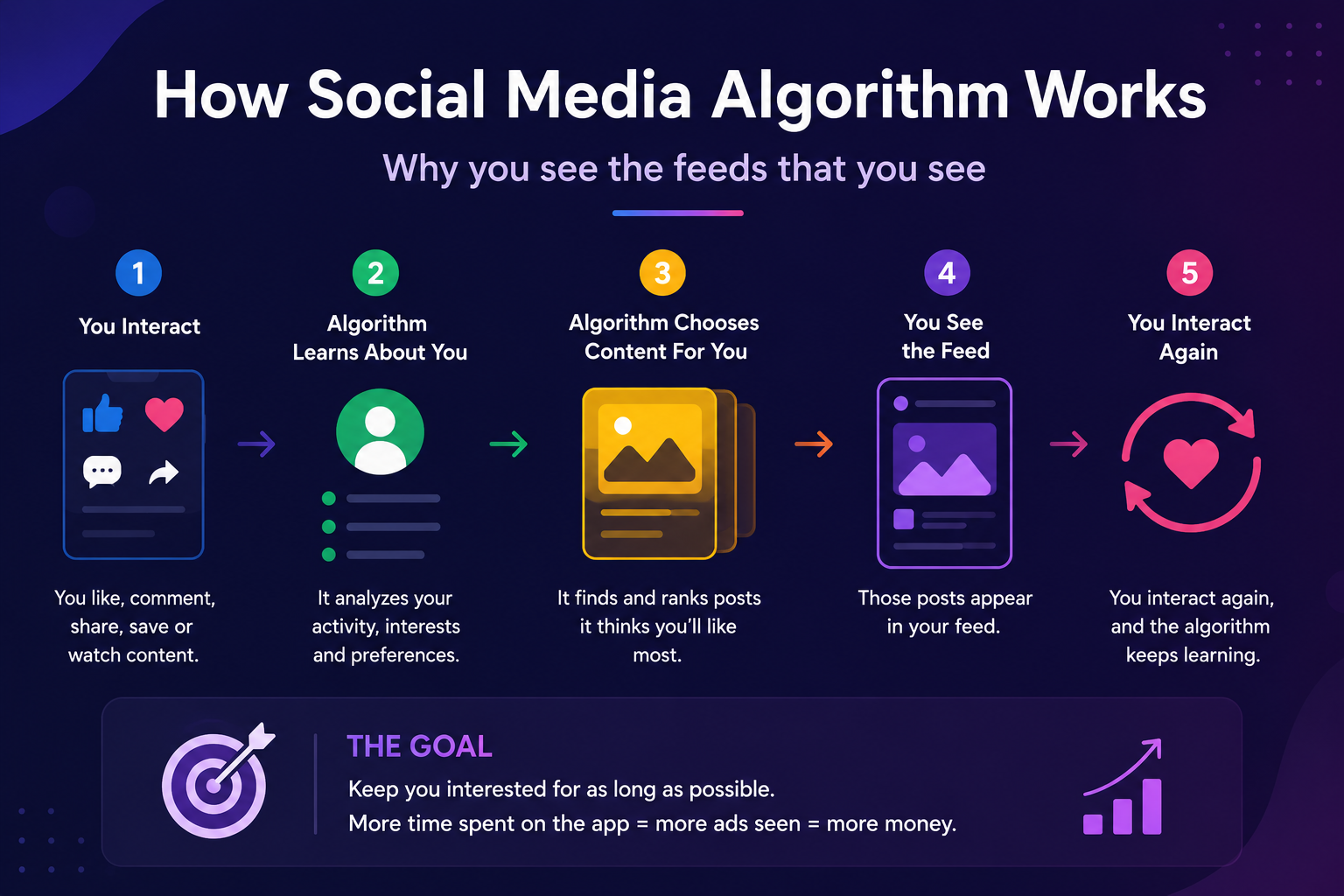
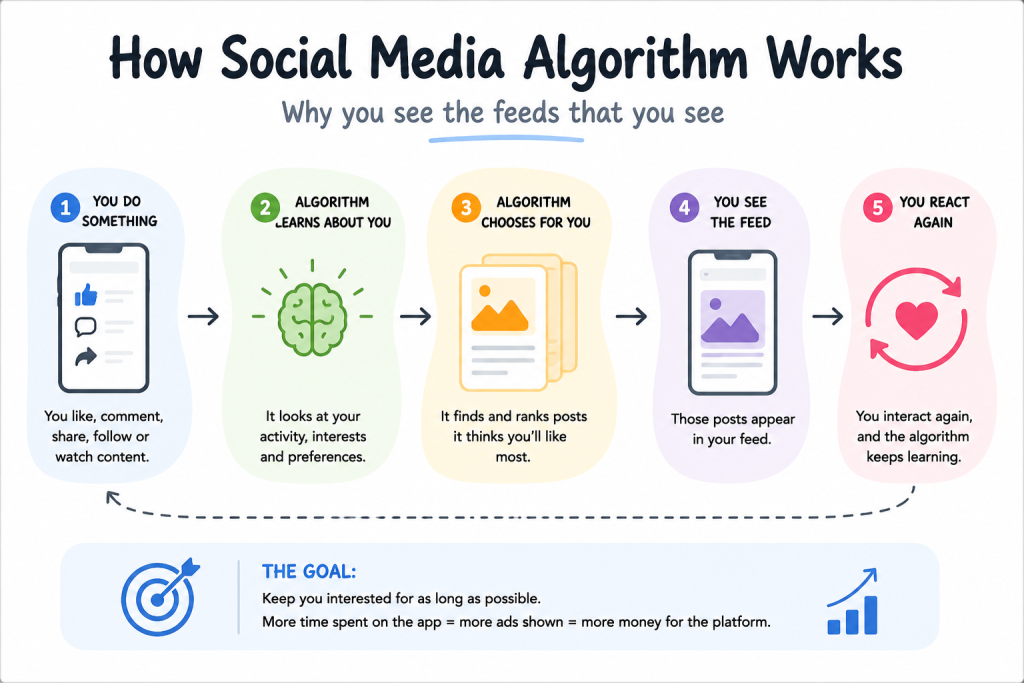
How the Algorithm Learns About You
One of the biggest misconceptions is that social media apps listen to your conversations.
In reality, algorithms usually don’t need to.
Instead, they learn from your digital behavior.
Every action sends a signal about your interests.
These signals include:
- Posts you like
- Videos you watch until the end
- Comments you leave
- Accounts you follow
- Stories you view
- Content you share
- Topic’s you search for
- Posts you save
- Time spent viewing certain content
- Profiles.you frequently visit
Individually, these actions may seem minor, but together they create a detailed picture of your interests.
For example, if you consistently watch football videos to the end while quickly scrolling past cooking videos, the algorithm concludes that sports interests you more that recipes.
Over time, your feed gradually changes to reflect those preferences.
The Technology Behind Every Feed
Social media algorithms rely on several advanced technologies working together.
Machine Learning
Machine learning allows computers to improve without being directly programmed from every situation.
Instead of following fixed instructions, the system studies millions of examples and learns patterns.
If millions of users who enjoy technology videos also tend to like smartphone reviews, the algorithm notices this relationship.
Eventually, it begins recommending smartphone reviews to people who enjoy similar content.
The more people interact with the platform, the smarter the algorithm becomes.
Artificial Intelligence (AI)
Artificial Intelligence helps platforms understand the content itself.
AI can recognize:
- Faces
- Objects
- Animals
- Text inside images
- Spoken words in videos
- Music
- Emotions in some cases
- Video topics
For example, even if a creator never writes “technology” in a caption, AI may recognize laptops, Smartphones, coding screens, or gadgets within video.
This helps categorize content more accurately.
Big Data
Every second, social media platforms process enormous amounts of information.
Billions of likes, comments, shares, uploads, searches, and views happen every day.
The massive collection of information is called Big Data.
Algorithms analyze this data continuously to improve recommendations and anticipate user interests.
How Post Are Ranked
When you open a app, thousands of possible post compete for a place in your feed.
The algorithm scores each post using many different factors.
This may include:
Your Relationship With the Creator
If you frequently interact with someone posts, the platform assumes you enjoy their content.
Their future posts are therefore more likely to appear.
Engagement
Posts receiving many likes, comments,shares, and saves often receive higher rankings
High engagement suggests that many people find the content valuable.
Watch Time
For videos, one of the strongest signals is how long people watch.
If viewers consistently watch until the end, the algorithm sees this as high-quality content.
Relevance
Algorithms compare your interests with the topic of each post.
Someone interested in photography may see camera tips, while someone interested in gaming sees gaming videos instead.
Freshness
Newer posts often receive some focus, especially if they are already gaining engagement quickly.
However, quality and relevance usually matter more than posting time alone.
Why Two People See Different Feeds
No two user have identical feeds.
Even if two friends follow the same accounts, their feeds will differ because each person interacts differently.
One might enjoy travel content.
The other prefers technology news
The algorithm adapts separately for each user.
The personalization explains why everyone’s experience feels unique.
Why Videos Often Go Viral.
Sometimes a video from an unknown creator suddenly reaches millions of people.
This happens because algorithms often test new content with a small audience first.
If that audience watches, likes, comments, or shares the video at unusually high rates, the algorithm expands its reach.
If engagement continues to increase, the video may spread to millions of users worldwide.
This process allows new creators to grow without already having a massive following.
Why You Keep Seeing Similar Content
Have you ever watched one gardening video and suddenly your feed became filled with plants?
This happens because algorithms look for patterns.
One strong interaction is not always enough, but several interactions within the same topic convince the algorithm that you have developed a new interest.
Your recommendations then shift accordingly.
The good news is that this also works in reverse.
If you stop engaging with certain topics, your feeds gradually changes over time.
The Benefit of Social Media Algorithms
Algorithms are not necessarily good or bad, they are tools.
When used well, they offer several advantages.
They help users discover creators they might never have found otherwise. They recommend educational videos,news updates, tutorials, career advice, entertainment, and communities based on individual interests. Businesses can reach customers who are genuinely interested in their products, while creators have an opportunity to grow their audience without relying completely on followers.
Without algorithms, discovering relevant content on today’s massive social media platforms would be much more difficult.
The Downsides of Algorithms
Despite their benefits, algorithms also have drawbacks.
They can create “filter bubbles” where users mostly see opinions that match their own while rarely encountering different perspectives. Sensational or emotionally charged content often attracts more engagement, which may cause it to spread more widely than balanced information. Algorithms can also encourage excessive screen time by continually recommending content that keeps people scrolling.
For those reasons, it is essential to use social media mindfully and seek information from variety of trusted sources.
How to Make the Algorithm Work for You
Whether you are a regular user or a content creator, understanding the algorithm can improve your experience.
As a user:
- Engage with content you genuinely enjoy.
- Use features like “Not Interested” to improve recommendations.
- Follow creators who consistently provide value.
- Avoid interacting with misleading or low quality content if you do not want more of it.
As a creator:
- Focus on creating useful, entertaining, or informative content.
- Encourage meaningful comments and discussions.
- Keep viewers engaged, especially during the first few seconds of a video.
- Post consistently so the algorithm has more opportunities to recommend your content.
- Prioritize quality over quantity.
Remember, the algorithm rewards content that people genuinely enjoy, not just content that is frequently posted.
The Future of Social Media Algorithms
As artificial intelligence continues to evolve, social media algorithms are becoming even more advanced.
Future algorithms may better understand context, recognize user intention more precisely, and deliver increasingly personalized recommendations. At the same time, governments and technology companies are facing growing pressure to make algorithms more transparent, reduce harmful content, and give users greater control over what they see.
The technology behind social media feeds will continue to change, but it’s main purpose will remain the same: helping users discover the content they are most likely to find valuable.
Conclusion
Every time you open a social media app, an invisible system goes to work in the background. It analyzes your interests, predicts what you will enjoy, and carefully selects the posts that appear in your feed.
Although these algorithms can sometimes feel mysterious, they are not magic. They are built on technologies such as artificial intelligence, machine learning, and big data, all working together to personalize online experience.
The next time a post seems surprisingly relevant, you will know there is an intelligent algorithm working behind the scenes—learning, adapting, and constantly refining what appears with every scroll.