

 How Do Automatic Doors See You Without Eyes?
Have you ever walked towards a supermarket entrance with your hands full of shopping bags, only for the glass doors to slide open just in time? You do not press a button, knock on the glass, or announce your arrival. The doors simply opened as they knew you were coming.
But automatic doors cannot read minds. They rely on sensors, electronic controllers, and motors working together to detect movement, decide when to open, and keep the doorway safe.
These systems are more interesting than they appear. Some detect movement, others sense body heat, and certain systems use a combination of technologies to distinguish someone approaching from someone standing nearby.
So, how do automatic doors work, how do they know when to open? Let us step behind the glass and explore the technology.
1. How Do Automatic Doors Work?
Automatic doors operate through a simple sequence: detect, process, and respond.
First, a sensor monitors the area around the entrance. When it detects a person or movement that meet its programmed conditions, it sends a signal to an electronic controller.
The controller acts like the door’s decision-maker. It receives the sensor’s signal and determines whether the door should open. If the conditions are satisfied, it activates a motor that moves the door along its track or operates its opening mechanism.
Once the person has passed through, the system waits until the doorway is clear and then closes the door, provided it’s safety settings allow it to do so.
Think of it as a small team working together:
- Sensor: Detects someone approaching.
- Controller: Processes the signal and decides what action to take.
- Motor: Opens or closes the door.
- Safety sensors: Help prevent the door from closing on someone or something in its path.
The entire process can happen within a fraction of a second. By the time you reach the entrance, the system may already have detected you and started opening the door.
However, the real magic lies in how the sensor recognises that something is approaching in the first place.
2. Motion Sensors: How Doors Detect Movement
One of the most common technologies used in automatic doors is the motion sensor.
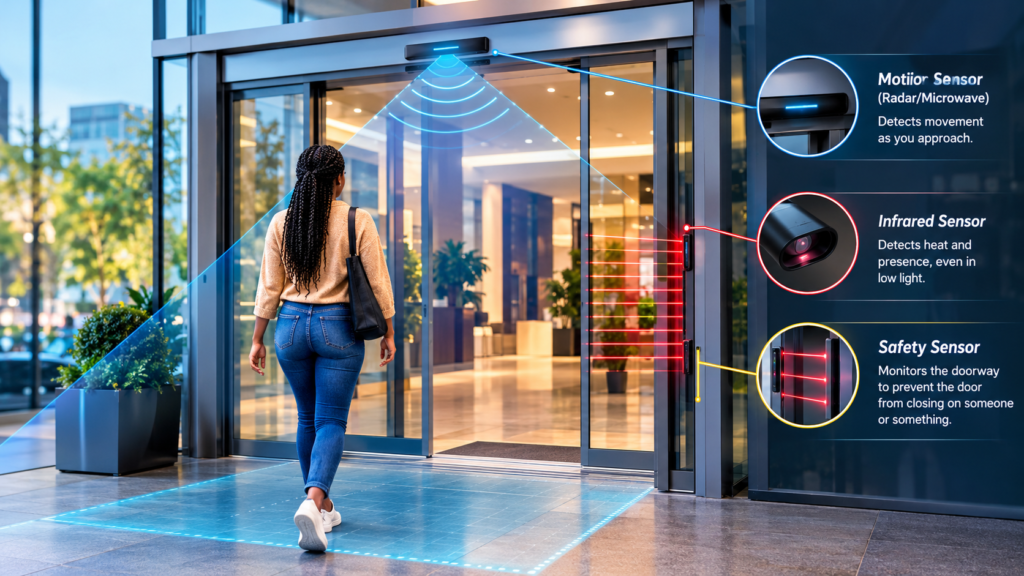
Many automatic sliding doors use microwave radar sensors to detect movement near an entrance. These sensors emit electromagnetic waves and analyze the waves reflected by objects in their detection area.
When a person walks towards the door, the reflected signal changes. The sensor detects this change and sends a trigger to the controller.
Some radar systems use the Doppler effect, which helps them identify movement by detecting change in the frequency of the reflected waves.
You do not need to wave your hands or make a sound. Simply moving into the sensor’s detection zone may be enough.
Imagine approaching a shopping mall while carrying a bag in each hand. A properly positioned radar sensor can detect your movement and trigger the doors before you reach them.
However, there is an important limitation: motion detection does not necessarily mean the sensor knows exactly who or what is moving. Depending on its design and settings, it may also respond to other moving objects.
This is why sensor placement and adjustment matter. A sensor that is too sensitive or poorly positioned could trigger the door when someone walks past the entrance rather than towards it.
3. Infrared Sensors: Detecting People and Obstacles
Infrared technology is another important part of automatic door systems, but not all infrared sensors work in the same way.
Two common types are active infrared sensors and passive infrared sensors.
Active infrared sensors
Active infrared sensors emit infrared light and measure what happens when that light encounters an object.
Depending on the design, the sensor may analyse reflected light or use beams directed across a specific area. When a person or object enters the direction zone, the returning signal changes or the beam is interrupted.
Some automatic door systems use active infrared technology to detect people near the entrance or monitor the area around a moving door.
Passive infrared sensors
Passive infrared (PIR) sensors work differently. They do not need to send out infrared light. Instead, they detect changes in infrared radiation emitted by objects in their surroundings.
Human bodies emit infrared radiation because they are warmer than their surroundings. When someone moves across a PIR sensor field of view, the pattern of detected infrared energy changes.
PIR sensors are widely used in motion-activated lighting and security systems. Their suitability for automatic doors depends on the particular application and sensor design.
Unlike a typical microwave radar sensor, a PIR sensor responds to changes in infrared radiation rather than measuring reflected radio waves.
The key difference: Radar sensors detect movement through reflected electromagnetic waves, while passive infrared sensors detect changes in thermal radiation.
Neither technology is perfect in every environment. Temperature differences, sunlight, background movement, sensor positioning, and the door’s intended use can affect performance.
4. Do Automatic Doors Use More Than One Sensor?
Yes. Some automatic door systems combine different sensing technologies because detecting an approaching person and ensuring that the doorway is safe are two separate jobs.
For example, a sliding entrance might use a radar sensor to trigger opening when someone approaches. It may also use infrared-based presence sensors or light curtains to monitor the doorway while the door is moving.
This combination helps the system do more than simply react to movement.
Consider what happens when you walk into a supermarket with a child beside you. The activation sensor triggers the door to open. As both of you pass through, a separate safety system may monitor the doorway to help prevent the moving panels from closing while either of you is in a protected area.
The activation sensor asks, “Should the door open?”
The safety sensor asks, “Is it safe for the door to close?”
That distinction is essential. A door that opens reliably but closes while someone is still passing through would be a poorly designed entrance.
Not every automatic door uses the same combination of sensors. The equipment varies according to the door type, installation, manufacturer, and applicable safety requirements.
5. How Do Automatic Doors Avoid Hitting People?
Automatic doors are designed to do more than open at the right moment. They must also reduce the risk of trapping, striking, or crushing people as the door moves.
Several safety mechanisms help achieve this.
Presence detection
Some systems monitor areas around or between the moving door panels. If a person or object remains within a protected zone, the controller can prevent the door from closing or stop its movement, depending on the system’s design.
Light curtains and infrared beams
A light curtain creates a detection zone using multiple light beams. If an object interrupts the monitored beams, the system receives a signal that the area is occupied.
Other systems use individual infrared beams or scanning sensors to monitor specific zones.
These technologies can help detect a person who has stopped in the doorway rather than continuing to walk through it.
Force and movement controls
Automatic doors may also incorporate limits on operating force, controlled movement, and other protective measures. Some designs use additional sensors or monitoring systems to detect an obstruction.
If the door encounters resistance, the controller may stop or reverse its movement, depending on the mechanism and its safety configuration.
Timers and controlled closing
Doors are usually programmed to remain open long enough for people to pass through. They then close when the opening cycle and safety conditions permit it.
The timing must balance convenience, energy efficiency, and safe passage.
Even with these mechanisms, automatic doors are not completely risk-free. Faulty equipment, inadequate maintenance, poor installation, or incorrect sensor settings can create hazards. People should still avoid deliberately blocking or testing moving doors.
6. Why Do Automatic Doors Sometimes Open Without Anyone Standing Directly in Front of Them?
If you have ever watched automatic doors open while you were still several steps away, you might have wondered whether they are reacting to someone behind you.
Often the explanation is simple: the sensor’s detection zone extends beyond the doorway.
Installers configure the sensor to detect approaching people early enough for the door to open before they arrive. This makes the entrance feel natural instead of forcing people to stop and wait.
However, the sensor may also detect someone walking past the entrance, depending on its detection pattern and settings. Nearby movement or environmental interference can sometimes cause unexpected activation.
Some doors may also open because another person has triggered the system from the opposite side.
The doors are not predicting your intentions. They are responding to signals from a defined detection area.
7. Why Do Some Automatic Doors Use Buttons Instead
Not every automatic door opens simply because someone approaches.
Some use push buttons, touchless activation switches, access cards, or other controls. These alternatives can be useful where more deliberate activation is needed or where the entrance has particular accessibility or security requirements.
A push-button door, for instance, waits for a person to press the button before the controller starts the opening cycle. A touchless switch may activate the door when someone moves a hand near a designated area
In buildings with restricted access, a card reader or another authorisation system may determine whether the door is permitted to open.
These systems illustrate an important point: automatic movement does not always mean automatic detection. A door can operate its motor automatically while relying on a human action or an access-control signal to begin the process.
8. Are Automatic Doors the Same as Smart Doors?
Not necessarily.
A conventional automatic door follows predefined instructions using sensors, a controller, and a motor. It may open when movement is detected, remain open for a set period, and close when it’s safety conditions are satisfied.
A smart door system may add connectivity, remote monitoring, access management, usage reporting , or integration with a building management system.
For example, a facility manager might be able to monitor door faults or review access events through a connected system.
However, a connected door is not automatically powered by artificial intelligence. Most everyday automatic doors rely on established sensing and control technologies rather than learning who is approaching.
Their apparent intelligence comes from well-designed sensors and carefully programmed responses.
Conclusion: The Technology Behind an Ordinary Entrance
Automatic doors are a good example of how technology quietly simplifies everyday life.
A sensor detects movement or a change in its surroundings. An electronic controller Processes the signal, and a motor moves the door. Additional safety systems monitor the doorway to help protect people as they pass through.
Radar, active infrared, passive infrared, and presence-detection systems all have different strengths and limitations. The technology selected depends on what the door needs to detect and how the entrance must operate.
The next time a supermarket door slides open just as you approach, remember that it is not reading your mind. It is responding to a carefully designed system of sensors, electronic decisions, and mechanical movement.
And that simple entrance is doing more work than most of us ever notice.