

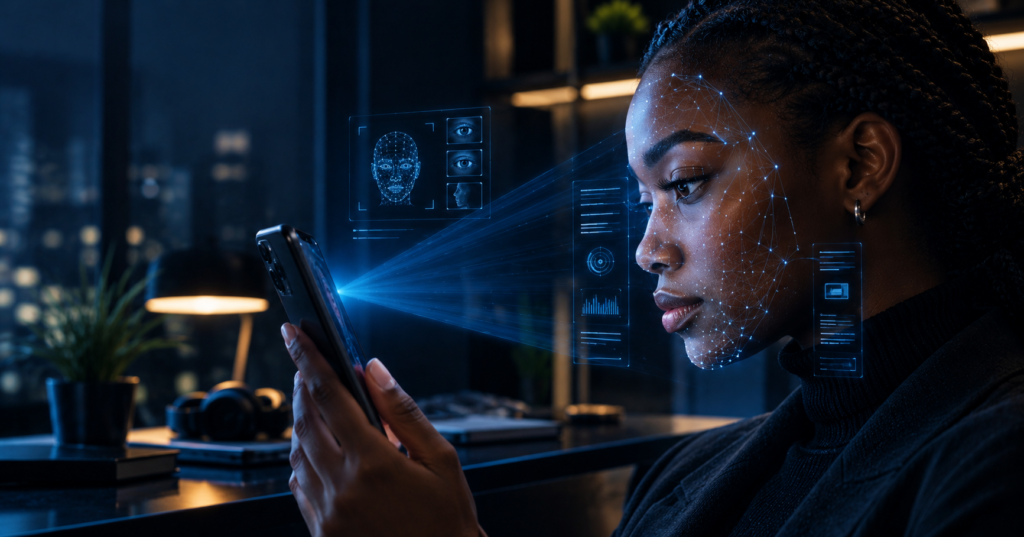
Your Face Is the Password: The Invisible Technology Behind Face Recognition
Long before a smartphone could recognize a face, humans were already remarkably good at doing it.
Imagine a crowded marketplace hundreds of years ago. A woman arrives after travelling for days. Before she says her names, someone across the crowd recognizes her.
“Is that you?”
There is no database. No camera. No password. No computer quietly calculating the distance between two eyes.
There is only memory.
The shape of a familiar face. The way someone smiles. The curve of your noise. Perhaps even the way they walk.
Humans have always used faces to recognize one another. It is one of the most natural things we do.
But eventually, we began asking a very different question:
Could a machine do the same thing?
The idea sounds simple today. We point a phone toward our face, wait for a tiny moment, and the screen unlocks. We barely think about it.
But getting a machine to recognize a human face was anything but simple.
The journey from human memory to machine recognition took decades of experimentation in photography, computer science, mathematics, pattern recognition, and eventually artificial intelligence.
Today, that technology sits quietly in our pockets.
It unlocks phones. It verifies identity. It helps organize photographs. It can assist with security and travel. In some places, it is even becoming part of how people interact with financial and public services.
Something humans once did naturally with their eyes has become a sophisticated digital process.
And the remarkable part is that we often experience the entire process in less than a second.
From Human Eyes to Machine Vision
Humans recognize faces almost effortlessly.
If you meet an old friend after several years, your brain may recognize them before you consciously remember their name.
A computer does not have that natural ability.
For a machine, a face is initially just an arrangement of pixels and patterns.
The challenge for early researchers was therefore enormous: how do you teach a machine to distinguish one face from another?
Researchers began experimenting with computer-based facial analysis decades ago. Early approaches were much more limited than the systems we use today. Computers had to rely on carefully defined measurements and patterns.
As computing power increased and digital cameras became common, facial recognition became increasingly practical.
Then came a major transformation: machine learning.
Instead of programmers having to describe every possible characteristic of a face, computers could increasingly learn patterns from large amounts of data.
That changed the possibilities.
The technology moved from simply looking for predetermined patterns toward recognizing much more complicated relationships with images.
What began as an ambitious scientific experiment eventually became something many people use before breakfast.
What Is Face Recognition?
At its simplest, face recognition is a biometric technology that uses characteristics of a person’s face to identify or verify them.
The word biometric is important.
Biometrics refers to using measurable characteristics of a person for identification or authentication.
Your fingerprint is a biometric.
Your face can be a biometric.
Your voice can also be used as a biometric.
The attraction is obvious: these characteristics are naturally connected to you.
You do not have to remember them.
You do not have to carry them in your pocket.
Your body provides them.
Face recognition generally performs one of two tasks.
Verification
Verification asks:
“Are you really the person you claim to be”
This is similar to what happens when your smartphone checks your face before unlocking.
The phone already knows which user it expects.
It simply needs to determine whether the person looking at it matches that identity.
Identification
Identification asks a different question:
“Who is this person?”
Instead of comparing a face with one expected identity, a system may compare it against a larger collection of stored identities.
That distinction becomes particularly important when discussing security, surveillance, and privacy.
Your Face Is More Than a Photograph
Here is where things become fascinating.
A face recognition system is not looking at your photograph and thinking:
“yes, that is Evelyn.”
Computers do not recognize faces in quite the same way humans do.
Your face contains many measurable characteristics.
The distance between your eyes.
The shape of your jaw.
The position of your nose.
The structure around your cheeks.
The relationship between different facial features.
The system can analyse these characteristics and turn them into mathematical information.
You can think of this as creating a kind of digital representation of your your face.
It is not necessarily a traditional photograph.
Instead, it is information that allows a computer to compare one facial representation with another.
Imagine meeting someone who looks remarkably similar to your friend.
You might say:
“They look alike, but something is different,”
A facial recognition system attempts to make that comparison mathematically.
How Does Face Recognition Actually work?
The exact technology varies between devices and systems, but the basic process can be explained in a few stages.
1. It Finds Your Face
First, the system has to determine whether a face is present.
This sounds obvious until you consider everything else a camera can see.
A room might contain tables, Windows, chairs, walls, clothing, books, plants, and dozens of other objects.
The software has to identify the region that contains a human face.
This is known as face detection.
And it is different from face recognition.
Face detection asks:
“Where is the face?”
Face recognition asks:
“Whose face is it?”
That small distinction explains a lot about how these systems operate.
2. It Examines Facial Features
Once a face has been detected, the system can examine its characteristics.
It may analyse important points around the eyes, nose, mouth, cheeks, and jaw.
The goal is to understand the structure of the face rather than simply look at it as a photograph.
Imagine an artist sketching someone’s face.
The artist is not thinking about every individual pixel.They are looking at proportions, shapes, relationships, and distinctive characteristics.
A computer approaches the problem differently, but the underlying idea of finding meaningful patterns is similar.
3. Your Face Becomes Data
The system then converts the information it has analyzed into a mathematical representation.
This is sometimes called a facial template.
Think about what happens when you save someone’s phone number.
You do not memorize every detail about that person. You store a compact piece of information that helps you identify and contact them later.
A facial templates serves a completely different technical purpose, but the analogy is useful: the system needs a representation that can be stored and compared.
4. It Compares the New Face
Now the interesting part begins.
The system compares the newly captured facial information with the information it already has.
The comparison does not necessarily ask whether two images are perfectly identical.
Instead, the system calculates how closely they correspond according to its design.
If the similarity meets the required threshold, authentication may proceed.
If it does not, the device may remain locked.
All of this can happen incredibly quickly.
You simply look at your phone.
The system does the rest.
5. It Makes a Decision
Finally, the technology makes a decision.
Match: access granted
No match: access denied or another authentication method requested.
That tiny moment when your phone unlocks is therefore the final result of a surprisingly complicated chain of events.
Why Can’t You Just Hold Up a Photograph?
If a camera is looking at your face, a reasonable question follows:
Could someone simply hold a photograph of you in front of the camera?
This is where modern biometric systems may use liveness detection.
Liveness detection is designed to help determine whether the system is interacting with real person rather than a photograph, recording, or other imitation.
Depending on the technology, the system may analyze things such as movement, depth, facial behavior, reflections, or other signals.
Some advanced devices use additional sensors to understand the three-dimensional structure of a face.
This adds another layer of security.
Of course, no technology should be treated as completely impossible to defeat. Security depends on how the system is designed, implemented, updated, and protected.
But the goal is clear:
The system needs to know that you are actually there.
Where Do We Encounter Face Recognition?
You might be surprised by how many places facial recognition or related facial technologies can appear.
Your Smartphone
This is probably the most personal example.
For many people, facial authentication has replaced the moment of typing a password or PIN.
You pick up your phone.
You look at it.
You are in.
The technology disappears into the experience.
And that is actually one of the greatest achievements of modern technology: making something extremely complicated feel ordinary.
Airports
Airports have become another environment where biometric identification can be useful.
Facial systems can assist with identity verification at certain stages of travel.
Instead of repeatedly presenting documents at every interaction, a traveler may encounter automated biometric checks designed to connect their face with their travel identity.
The goal is often speech and convenience, although the use of biometrics travel also raises important questions about privacy and data protection.
Banking
Imagine opening a bank account without walking to the branch.
You upload an identity document, take a photograph or video of yourself, and the system checks whether the person in front of the camera matches the identity being presented.
This kind of process can make digital financial services easier to access.
But because banking involves highly sensitive information, accuracy and security are very important.
Photography and Social Apps
Facial technology can also appear in everyday photography.
Your phone may detect faces in photographs so it can focus more effectively.
Photo applications may group or organize images based on people.
Filters can track facial features and place digital effects around the eyes, mouth, or other parts of the face.
You might simply see a funny filter.
Behind that funny filter is computer vision.
Security
Organizations can also use biometric technology for identity verification and controlled access.
Instead of relying entirely on keys, passwords, or access cards, a person’s face can become another layer of authentication.
The important phrase here is another layer.
Biometrics can be useful, but good security generally involves more than simply choosing one technology and trusting it completely.
Why Do People Like Facial Recognition?
The biggest advantage is simple:
Convenience.
Passwords can be forgotten.
Keys can be misplaced.
Access cards can be lost.
Your face is already with you.
There is no need to search your bag for it.
There is no need to remember whether you used a capital letter in your password.
You simply look.
For everyday technology, that kind of frictionless interaction can feel almost magical.
But convenience always comes with a responsibility.
The easier technology becomes to use, the easier it can become to forget that something powerful is happening underneath.
When Your Face Becomes Sensitive Data
Here is where the conversation becomes more complicated.
A password can be changed.
A stolen card can be cancelled.
A compromised account can sometimes be reset.
Your face is different.
You cannot simply wake up one morning and decide:
“I will get a new face because the old one has been compromised.”
That makes biometric information particularly sensitive.
People should therefore care about what happens to their facial data.
Is it stored on the device?
Is it sent to a server?
Who can access it?
How long is it retained?
Is it protected?
Can it be deleted?
These questions matter because technology does not exist separately from human life.
A facial recognition system is not simply processing numbers and images.
It is processing information connected to real people.
The Question of Privacy
Facial recognition has created exciting possibilities, but it has also created difficult debates.
Imagine walking through a public space and wondering whether a camera is simply recording the environment or actively analyzing the faces of the people passing by.
That is a very different experience.
The issue is not necessarily whether facial recognition is good or bad.
The more useful question is:
When should it be used, and under what rules?
There are situations where people may willingly choose facial authentication because it makes their lives easier.
There are other situations where people may reasonably expect more privacy and control.
That distinction matters.
Technology becomes more trustworthy when people understand how it works and have meaningful protections around its use.
What About Accuracy?
Another essential issue is accuracy.
Facial recognition system can be affected by lightning, camera quality, facial position, changes in appearance and other factors.
A person’s appearance can change over time.
Hair grows.
Beards appear and disappear.
People age.
Glasses are added.
Faces change.
Even humans sometimes struggle to recognize someone they have not seen for years.
Computers face their own challenges.
There is also an important question about whether systems perform equally well across different groups of people.
If a technology is going to make decisions about human being, it needs to be tested carefully.
It is not enough to say:
“The system works.”
We should ask:
How well does it work?
Under what condition?
For whom?
And what happens when it gets it wrong?
Those questions belong at the center of responsible technology development.
What Does the Future Look Like?
Facial recognition is unlikely to disappear.
If anything, it may become less visible.
That may sound strange, but the future of technology often works that way.
The best technology does not always demand our attention.
It quietly becomes part of the background.
Facial authentication may increasingly work alongside other security technologies.
A system might consider multiple signals rather than relying on a single biometric characteristic.
Devices could become better at distinguishing genuine users from attempts to imitate them.
Digital services could use facial verification to simplify certain identity checks.
At the same time, privacy protections and regulations will become increasingly important.
Because the future is not simply about building technology that can recognize us.
It is about deciding how that technology should interact with us.
The Face Looking Back at Us
The next time you pick up your phone and it unlocks before you have even thought about it, remember how strange that would have sounded to someone living a century ago.
A machine recognizing you by looking at your face would have belonged comfortably in the world of science fiction.
Today, it is part of breakfast routine, morning commutes, banking, photography, travel, and everyday communication.
That is what makes technology so fascinating.
The most extraordinary inventions eventually become ordinary.
We stop noticing them.
We stop asking questions.
We just make use of them.
But behind that effortless moment when a screen recognizes your face is a story of decades of scientific curiosity, mathematical ideas, computer vision, engineering, and human experimentation.
And perhaps that is the real lesson.
Technology is not only about machines becoming smarter.
It is also about humans finding new ways to translate the things we naturally understand—such as a familiar face—into something a machine can understand too.
Your face may now be a key.
But unlike a traditional key, it is part of who you are.
And as technology becomes better at recognizing us, the responsibility to protect that identity becomes just as important as the technology itself.