
 15 Everyday Apps That Secretly Use AI (And How It Is Making Your Life Easier)
Think about the first few apps you open every day. Maybe it is Google Maps to check traffic, Spotify to play your favorite songs, Whatsapp to chat with friends, or Instagram to catch up on the latest posts. These apps feel so natural to use that it is easy to forget there is powerful technology working behind the scenes.
That technology is artificial intelligence (AI).
While AI often brings to mind futuristic robots or advanced chatbots, the reality is much more practical. It is already built into many of the apps we depend on every day. AI quietly learns from patterns, analyzes data, and makes smart decisions to improve your experience. It helps recommend music you will enjoy, suggests the fastest route home, filters unwanted emails, and even enhances the photo you take.
The best part? Most of this happens without you noticing. Al works in the background, making everyday tasks faster, easier and more personalized.
In this article, we will explore 15 popular apps that secretly use AI and discover how this technology is transforming your daily digital life.
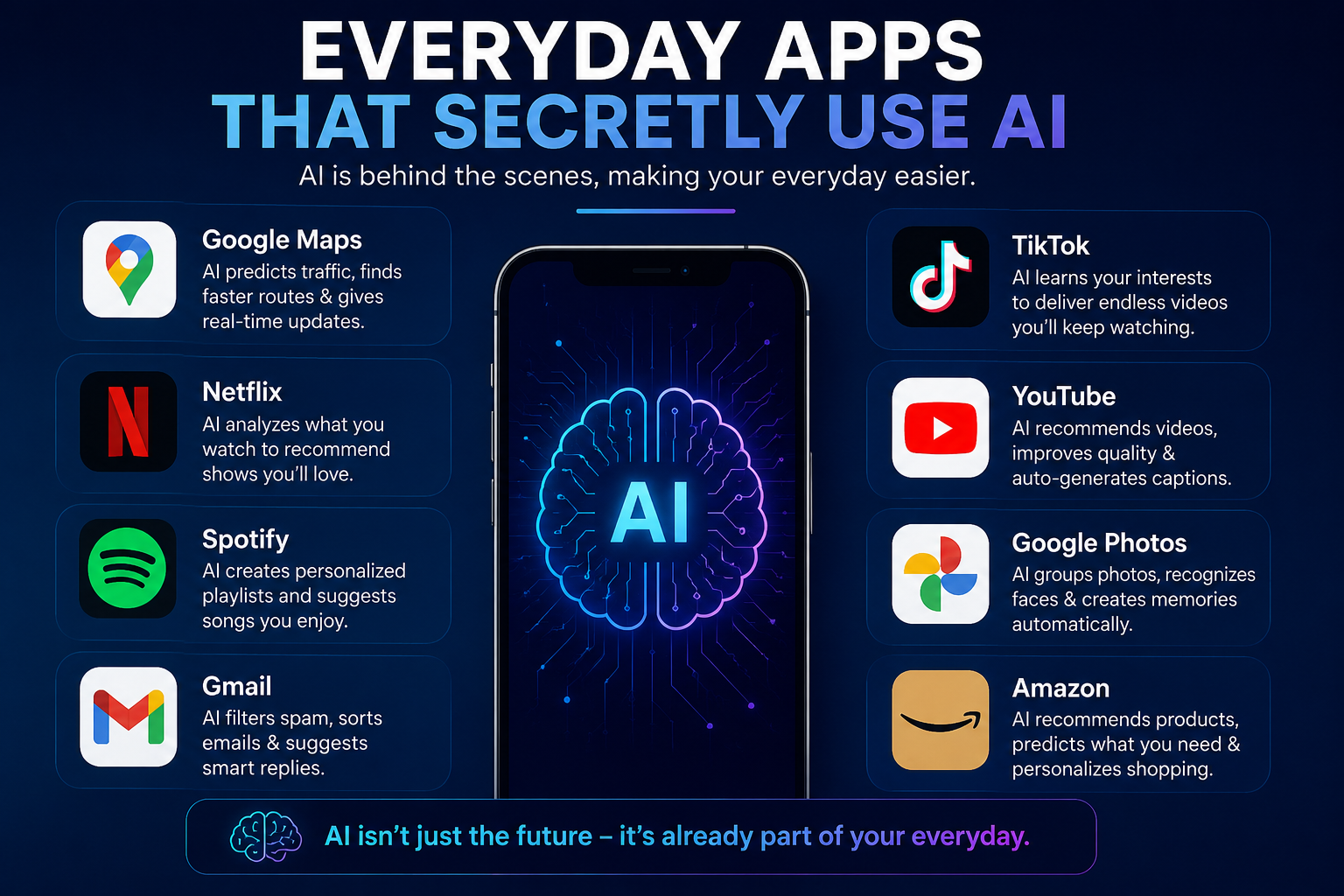
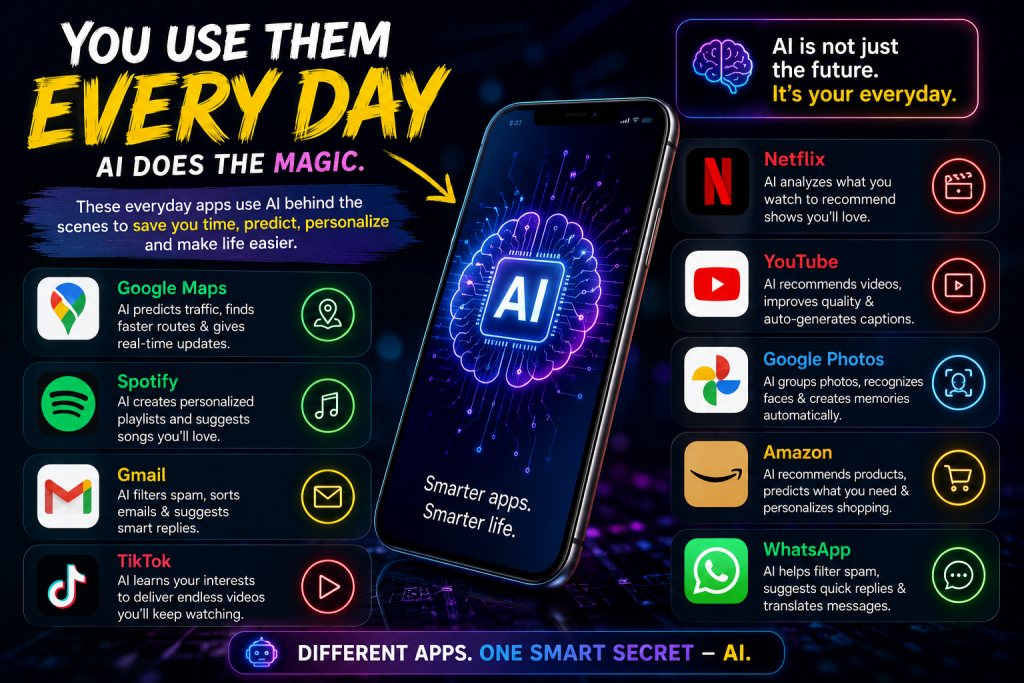
1. Google Maps
Have you ever wondered how Google Maps seem to know exactly which route will get you to your destination the fastest? The answer lies in AI.
Google Maps analyzes real-time traffic conditions, road closures, accidents, construction work, and even historical traffic patterns. By processing enormous amounts of data in seconds, AI can recommend the quickest route and provide an accurate estimate of your arrival time.
As you continue using the app, it also learns your travel habits, such as your frequent destinations and preferred routes. This allows it to make increasingly helpful suggestions, whether you are commuting to work or planning a road trip.
2. Spotify
Spotify does not just play music—it learns your taste.
Every song you play, skip, like, or save gives Spotify’s AI valuable information about your preferences. It looks for patterns in your listening habits and compares them with those of users who enjoy similar music.
That is how features like Discover Weekly, Daily Mix, and customized recommendations introduce you to songs and artists you might never have found on your own. Instead of simply shuffling random tracks, Spotify creates playlists tailored specifically to your musical interests.
3. Gmail
Your inbox would probably be flooded with spam if Gmail didn’t use AI.
Every day, Gmail’s AI scans billions of emails to identify phishing attempts, scams, and spam before they ever reach your inbox. It also powers features like Smart Reply and Smart Compose, suggesting quick responses or completing your sentences as you type.
These intelligent tools save time, reduce typing, and help you stay organized by automatically sorting emails into categories like Promotions, Social, and Primary.
4. Netflix
If you have ever spent an evening binge-watching your favorite series, you have experienced AI in action.
Netflix uses a AI to study what you watch, how long you watch it, the genres you prefer, and even the shows you stop watching halfway through. With this information, it recommends movies and TV shows that match your interests.
Even the artwork you see for a movie or series can be personalized. AI may display different cover images to different users based on what it believes will capture their attention. This makes finding something to watch quicker and more enjoyable.
5. YouTube
YouTube’s recommendation system is one of the most powerful examples of AI at work.
Everytime you watch a video, like a comment, subscribe to a channel or search for a topic, AI learns a little more about your interest. It uses this information to recommend videos on your homepage and in the “Up Next” section.
AI also generates automatic captions, helps creators reach the right audience, and detects harmful or inappropriate content. These features make YouTube more accessible while creating a curated viewing experience for every user.
6. Instagram
Your Instagram feed is not arranged by chance—AI decides what appears first.
The platform analyzes your activity, including the posts you like, the accounts you follow, the Reels you watch, and the content you share. Based on this information, it predicts what you are most likely to enjoy and places those posts higher in your feed.
7. TikTok
TikTok’s “For You” page is one of the clearest examples of AI-driven personalization.
Instead of showing everyone the same content, TikTok studies how you interact with videos. It pays attention to what you watch until the end, what you replay, the videos you like, and the creators you follow.
Within a short time, AI builds a unique content feed designed specifically for you. This highly exclusive approach is one of the reasons TikTok keeps users engaged and constantly discovering new creators.
8. Google Photos
Google Photos does much more than store your pictures—it uses AI to organize them intelligently.
The app can recognize faces, pets, landmarks, and everyday objects, making it easy to search for photos using simple words like “beach,” “birthday,” or “dog.” Instead of scrolling through thousands of images, you can find what you are looking for in seconds.
AI also enhances photo quality, creates automatic albums, suggests memories from previous years, and even recommends edits to improve lighting, color, or sharpness. It is like having a smart photo assistant that keeps your memories organized without any extra effort.
9. Google Translate
Google Translate has come a long way from simply converting words between languages. Today, AI helps it understand the context of sentences, making translations more natural and accurate.
The app can translate text, speech, and even words captured through your phone’s camera. Whether you are traveling abroad or communicating with someone who speaks a different language, AI makes breaking language barriers faster and easier.
10. Amazon Shopping
When Amazon recommends products that match your style, AI is doing the work privately.
It analyzes your browsing history, previous purchases, wishlists, and shopping habits to suggest products you are more likely to buy. AI also helps improve search results, detect fraudulent transactions, and manage inventory, ensuring products are available when customers need them.
11. Uber
Ordering a ride through Uber may seem simple, but AI handles many complex tasks in the background.
It matches riders with nearby drivers, predicts pickup and arrival time, calculates the fastest routes, and adjusts fares based on traffic and demand. By analyzing real-time data, AI helps make every trip more efficient for both drivers and passengers.
12. WhatsApp
While WhatsApp protects your conversations with end-to-end encryption, it also uses AI in several helpful ways.
AI helps detect spam messages, identify suspicious accounts, and reduce unwanted activity on the platform. New AI-powered features, such as message assistance and business tools, are also making communication more convenient while maintaining user privacy.
13. Google Assistant (or Siri)
Whether you are asking for today’s weather, setting a reminder, or controlling smart home devices, Google Assistant relies heavily on AI.
It uses speech recognition and natural language processing to understand what you say and respond in a conversational way. Over time, it learns your preferences and routines, allowing it to provide more relevant and optimized assistance.
14. Banking Apps
Many modern banking apps use AI to protect your money and improve your banking experience.
AI monitors transactions in real time and can quickly detect unusual spending patterns that may indicate fraud. Some banking apps also provide personalized budgeting tips, spending insights, and AI-powered chatbots that answer common customer questions around the clock.
15. Face Unlock
Unlocking your smartphone with your face is another everyday feature powered by AI.
Instead of simply comparing a photo, AI analyzes special facial features such as the distance between your eyes, the shape of your nose and other characteristics to verify your identity. This makes face recognition both convenient and more secure than many traditional unlocking methods.
Conclusion
Artificial Intelligence is not a technology that is waiting for the future—it is already part of your daily routine. From finding the fastest route on Google Maps to recommending your next favorite songs on Spotify, filtering spam in Gmail, and organizing your photos, AI quietly works behind the scenes to make everyday apps smarter and more useful.
As AI continues to evolve, these apps will become even better at understanding our needs, saving us time, and delivering more personalized experiences. At the same time, it is important to stay aware of how our data is used and to make informed choices about privacy and security.
The next time you open your favorite app, remember that there is a good chance AI is already helping you—even if you never notice it. That is what makes modern artificial intelligence so remarkable: it is not just changing the future; it is improving the present, one app at a time.