
How Artificial Intelligence Is Transforming Healthcare and Patient Care
The Doctor You Never Expected
Imagine waking up with a persistent cough and a slight fever. Instead of rushing to the hospital, you open an app on your phone. Within minutes, it analyzes your symptoms, reviews your medical history, compares your condition with millions of similar cases, and recommends the next steps. Later that day, your confirms the diagnosis and the AI was right.
This is not a scene from a science fiction movie. It is the reality of modern healthcare.
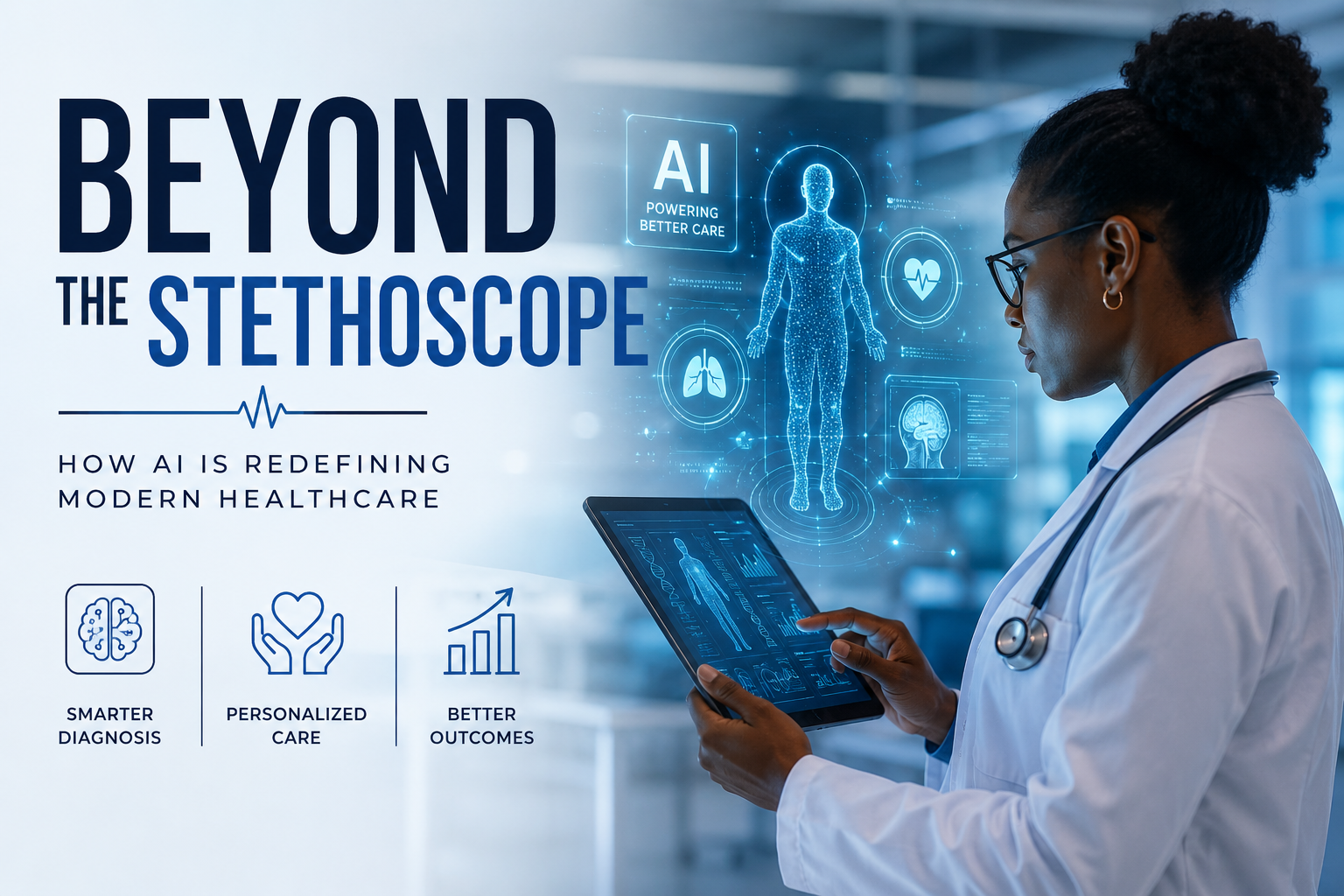
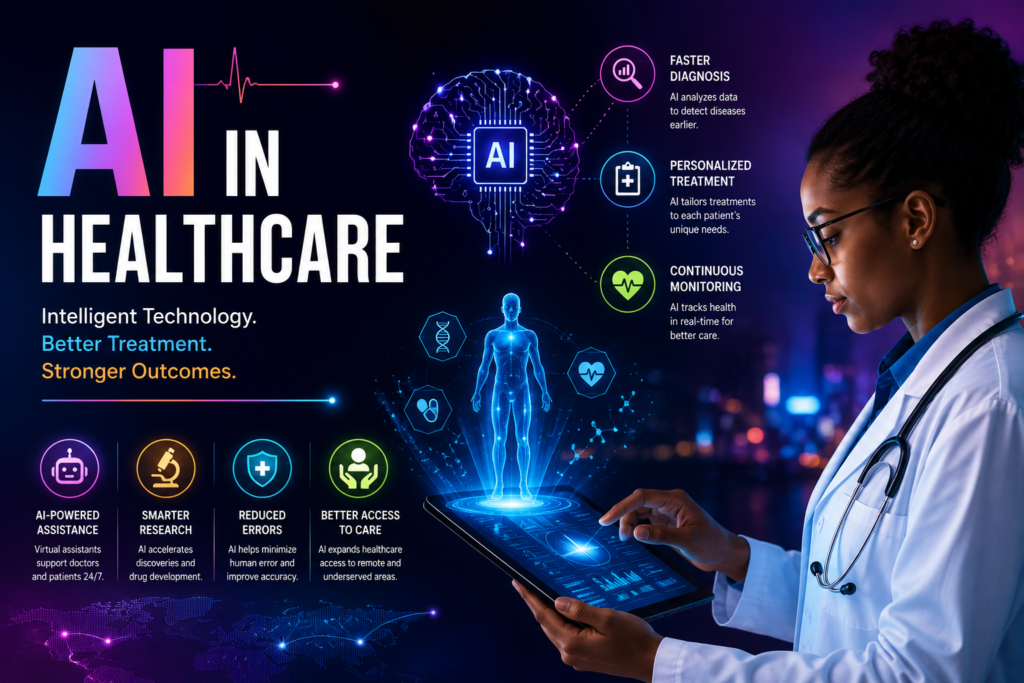
Artificial Intelligence (AI) is rapidly becoming one of the most powerful tools in medicine. While robots are not replacing doctors, AI is helping healthcare professionals diagnose diseases more accurately, detect illness earlier, develop personalized treatments, and even predict health risks before symptoms appear.
As healthcare systems face growing patient numbers, staff shortages, and increasing medical complexity, AI offers a smarter way to deliver faster, safer, and more efficient care. The future of medicine is not about replacing humans—it is giving them better tools.
What Is AI in Healthcare
Artificial Intelligence refers to computer systems that can perform tasks that normally require human intelligence. These tasks include learning from data, recognizing patterns, making predictions, and solving problems.
In healthcare, AI works behind the scenes by evaluating enormous amounts of medical information much faster than any human can. It helps doctors identify diseases, interpret medical scans, recommend treatments, and manage patient record more efficiently.
Think of AI as a highly intelligent assistant that never gets tired and can process millions of pieces of information in seconds.
Detecting Diseases Earlier
One of AI’s greatest strengths is finding diseases before they become serious.
Many illnesses, including cancer and heart disease, are easier to treat when discovered early. AI systems can examine medical images such as X-rays, CT scans, and MRIs, highlighting tiny abnormalities that might otherwise be overlooked.
Doctors still make the final diagnosis, but AI provides another layer of analysis that improves confidence and accuracy.
Earlier detection can mean:
- Better treatment outcomes
- Lower medical costs
- Faster recovery
- Higher survival rates
In many hospitals, AI is already supporting radiologists by identifying suspicious areas in medical images within seconds.
Helping Doctors Make Better Decisions
Doctors face thousands of medical decisions throughout their careers. AI helps by providing evidence-based recommendations.
Instead of replacing medical judgement, AI examines patient history, laboratory results, medications, allergies, and research findings to suggest possible diagnoses or treatment options.
For example, if two patients have similar symptoms but different medical histories, AI helps identify the treatment that is more suitable for each individual.
This partnership between human expertise and artificial intelligence leads to better-informed decisions and improved patient care.
Personalized Medicine
No two people are exactly alike.
Age, genetics, lifestyle, environment, and medical history all influence how someone responds to treatment.
AI allows healthcare providers to move away from a one-size-fits-all approach by creating customized treatment plans.
By reviewing large amounts of patients data, AI can recommend medications, adjust dosages, and predict how individuals may respond to specific treatments.
- This individualized approach reduces unnecessary treatments while improving effectiveness.
AI in Medical Imaging
Medical Imaging is one of the fastest-growing areas of AI.
Hospitals generate thousands of images every day, making it challenging for specialists to review every scan quickly.
AI assists by examining images almost instantly and identifying potential issues such as:
- Tumors
- Fractures
- Internal bleeding
- Lung infections
- Heart abnormalities
The technology speeds up diagnosis while allowing specialists to focus on the most urgent cases.
Virtual Health Assistants
AI-powered chatbots and virtual assistants are changing how patients interact with healthcare providers.
These digital assistants can:
- Answer health-related questions
- Schedule appointments
- Send medical reminders
- Monitor chronic conditions
- Provide basic health advice
Patients benefit from faster access to information, while hospitals reduce administrative workloads.
Although virtual assistants cannot replace medical professionals, they improve convenience and accessibility.
Predicting Health Problems Before They Happen
Perhaps one of AI’s most exciting abilities is prediction.
Using historical medical records, wearable devices, and health monitoring systems, AI can identify patterns that suggest future health risks.
For example, AI may detect early warning signs of:
- Diabetes
- Stroke
- Heart attacks
- Kidney disease
- High blood pressure
Doctors can then recommend lifestyle changes or treatments before serious complications develop.
Preventive healthcare could become one of AI’s biggest impact to medicine.
Improving Hospital Efficiency
Healthcare professionals spend significant time completing paperwork and administrative tasks.
AI automates many routine activities, including:
- Updating patients records
- Managing appointments
- Processing insurance information
- Organizing laboratory results
- Managing hospital resources
This saves valuable time, allowing doctors and nurses to focus more on patient care.
Hospitals also benefit from improved efficiency and reduced operating costs.
AI and Drug Discovery
Developing new medicines traditionally takes many years and billions of dollars.
AI is dramatically accelerating this process.
Researchers use AI to analyze biological data, identify promising drug candidates, and predict how new medicines might perform.
This shortens research timelines and helps scientists respond more quickly to emerging diseases.
The rapid development of several modern treatments has demonstrated how AI can support pharmaceutical research without replacing scientific expertise.
Robotic Surgery
AI-powered surgical robots are becoming increasingly common.
These systems assist surgeons by providing greater precision, improved visualization, and enhanced control during delicate procedures.
Benefits includes:
- Smaller incisions
- Less blood loss
- Reduced pain
- Lower infection risk
- Faster recovery
Importantly, surgeons remain fully responsible for every operation. The robot is an advanced surgical tool not an independent surgeon.
The Challenges of AI in Healthcare
Despite its advantages, AI also presents several challenges.
Data privacy
Healthcare data is extremely sensitive. Hospitals must protect patient information from unauthorized access and cyberattacks.
Strong security measures and privacy regulations are essential.
Bias in AI
AI systems learn from data.
If training data lacks diversity or contains bias. AI recommendations may not perform equally well for every population.
Developers must ensure AI systems are tested across different groups to provide fair and accurate results.
Cost of Implementation
Introducing AI requires investments in technology, infrastructure, and staff training.
Smaller hospitals may find adoption more difficult than larger healthcare institutions.
Human Trust
Some patients remain uncomfortable with AI participating in medical decisions.
Building trust requires transparency, rigorous testing, and clear communication that doctors not machines make the final decisions.
Will AI Replace Doctors?
This is one of the most common questions surrounding AI.
The answer is NO.
Healthcare is more than diagnosis and treatment. Doctors listen, reassure patients, explain difficult news, understand emotions, and make ethical decisions that machines cannot fully replicate.
AI excels at processing information, but compassion, empathy, communication, and human judgement remain uniquely human strengths.
Rather than replacing doctors, AI is becoming a powerful partner that enhances their abilities.
The most successful healthcare systems will combine advanced technology with skilled medical professionals.
Looking Ahead
The future of healthcare is likely to include even smarter AI systems.
We may soon see technologies that continuously monitor patients through wearable devices, detect diseases years earlier, recommend highly personalized treatment, and enhance access to healthcare in remote communities.
As AI continues to evolve, it success will depend on responsible development, strong privacy protections, and close collaboration between technology experts and healthcare professionals.
The goal is not to remove the human element from medicine—it is to strengthen it.
Conclusion
Your next doctor might not be human —but your next healthcare experience will certainly be influenced by artificial intelligence.
From detecting diseases earlier and supporting life-saving surgeries to personalizing treatments and improving hospital efficiency, AI is already reshaping medicine in remarkable ways.
The future belongs to healthcare professionals who embrace intelligent technology while continuing to provide the empathy, compassion, and personal connection that patients need most
In the years ahead, the best medical care will not come from humans or machines alone. It will come from both working together to create healthier lives for everyone.